A New Dystopia?
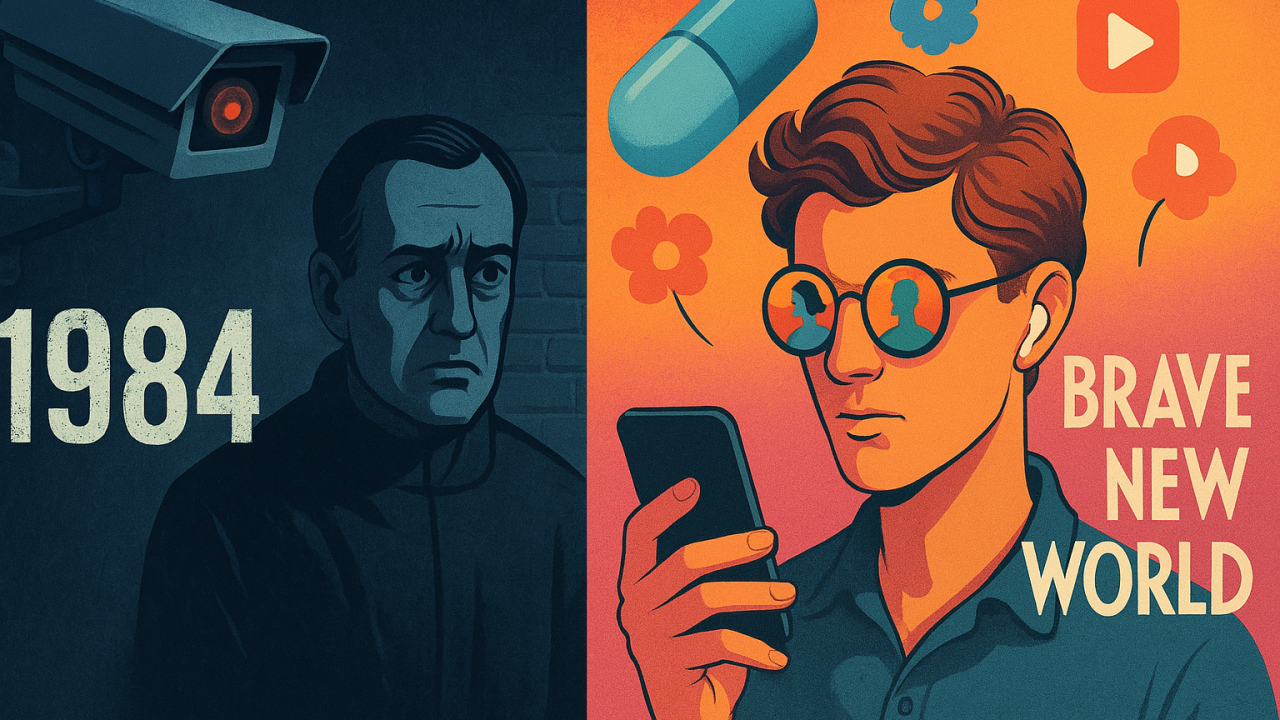
Are we seeing the rise of a new dystopia of our own creation?
Alex DiMarco
March 30, 2025
Are we living between two warnings? Is disconnection, distraction, and the loss of a shared reality creating a growing sense that something isn’t right?
We seem to live in a time when truth feels negotiable, where outrage moves faster than understanding, and where attention—our most personal and precious resource—is constantly under siege. We’ve come to expect immediacy, certainty, and stimulation. And yet, many of us feel more disconnected, more anxious, and more unsure than ever.
It’s hard not to see echoes of both Orwell and Huxley in this moment.
Orwell warned of control through fear, through the manipulation of truth and the pressure to conform. Today, disinformation flows through political messaging, social media feeds, and even casual conversations—shaping perception faster than we can fact-check it. Trust in institutions, journalism, and even in each other is thinning. Truth is still there, but it often gets buried beneath repetition and noise. Often our temptation is to follow the group rather than to question or seek truth which is becoming more difficult to discover and discern.
But Huxley’s warning feels just as present, if not more so. He feared we would be lulled into passivity not by force, but by pleasure. That we would be too distracted to notice what we were losing. The constant scroll of content, the curated lives we see online, the dopamine-driven design of our digital tools—it’s all designed to keep us engaged, but not necessarily connected. We seem to be lulled into accepting the illusion of connection rather than the reality of it, pursuing goals that are reinforced by algorithms that are programmed to growing company profits rather than our own personal choice or collective dialogue.
Psychiatrists, educators, and technologists are raising concerns about what this means, while political and social messaging works to discredit their perspectives into just another noisy opinion. Our attention spans are shrinking. Our ability to sit with discomfort, to focus deeply, and to empathize with others is fraying. The emotional distance this creates is subtle, but real. We’re present, but not really here. We hear, but we don’t always listen. We run away from conflict rather than participate in seeking truth or justice. We connect online speaking our minds – often without filtering – but fear personal interaction and real-world conversations.
And in this space, where confusion meets distraction, we lose something essential—not just the clarity of truth, but the quality of our relationships, seeking comfort in distraction rather than engagement.
This isn’t just a political or technological issue. It’s a relational one that hits the very core of who we are. How do we hold onto empathy in a world designed to fracture our focus? How do we stay grounded in meaningful relationships when we’re constantly nudged toward division, speed, and surface-level thinking?
The answer may not be fast or easy. But perhaps it starts with recognizing that how we pay attention matters and how we relate to others is crucially important. That truth and trust are not just intellectual concerns—they are emotional and relational ones. That “cancelling” each other out or bullying into compliance are both relational failures that lead to collective destruction. That success, both personally and collectively, cannot be measured only by efficiency or output, but by the strength of our connections and the integrity of how we move through the world. That the values we choose are directly influenced by how we spend our time and what we focus our lives on.
We are not just navigating external forces. We are making choices every day about what we attend to, what we believe, and how we relate. The challenge is not simply to resist manipulation or unplug from distraction, but to return—again and again—to presence, to empathy, and to the relationships that make us human.