Canada’s Cultural Values
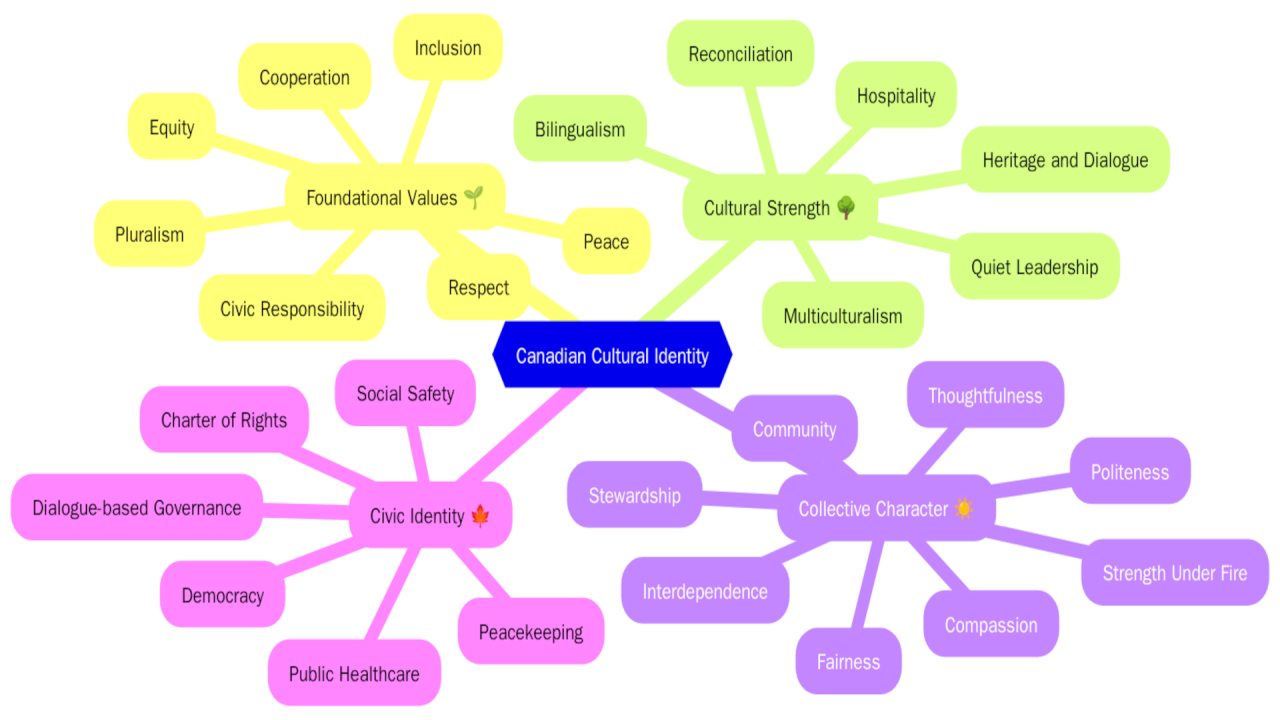
How Canada’s Cultural Values Can Anchor Us in a Time of Transformation
by Alex DiMarco
Canada is more than a nation. It is an ongoing conversation.
It is a dialogue between histories, between peoples, and between different visions of a shared future. We have never relied on sameness. Instead, we have built our core identity on a quiet understanding that difference is not a threat but a strength. Our cohesion has not come from dominance or ideology, but from mutual respect, balanced pragmatism, and the belief that we do better when we build together.
This approach has served us well.
From universal healthcare to peacekeeping, from cooperative governance to broad public trust in our systems, Canada has often taken a slower road. A road shaped by consensus over conflict, stability over spectacle, and the idea that long-term thinking beats short-term wins.
Now we find ourselves facing a period of intense transformation. The questions are no longer abstract. They are present, pressing, and real. What kind of country are we, and what kind do we want to remain?
A Tangle of Pressures, All at Once
It would be easier if we were dealing with a single issue. Instead, we are navigating multiple, interconnected challenges that are unfolding simultaneously.
Our demographic structure is shifting. Birth rates are at historic lows, and the population is aging. This affects the sustainability of public services and puts pressure on the younger workforce. According to Statistics Canada’s 2021 census analysis, our society is entering a new phase where fewer working-age Canadians are supporting more retirees (source1) (source2).
Housing affordability has become a point of stress and inequality. Many younger Canadians feel locked out of the kind of stability their parents once expected. A recent piece by TVO outlines how the affordability crisis is now the “greatest source of inequality in Canada” (source1) (source2).
Environmental signals are getting stronger. Wildfires, floods, and changing agricultural seasons are increasingly visible. The Regional Perspectives Report from Natural Resources Canada highlights how climate impacts are not felt evenly, with different regions facing distinct pressures and risks (source1) (source2).
We are also experiencing deeper political division. What used to be healthy disagreement has turned into sharper ideological splits, driven in part by misinformation and frustration. According to the Public Policy Forum, polarization in Canada is real and growing, and it is weakening trust in institutions and one another (source1) (source2).
Technology is reshaping the nature of work faster than institutions can adjust. Automation and artificial intelligence are shifting the demand for skills and displacing traditional roles. Statistics Canada has documented this rapid shift in a report on the changing nature of work from 1987 to 2024 (source1) (source2).
At the same time, our population is growing through immigration. This remains essential to Canada’s long-term future. But rapid growth has outpaced our infrastructure and planning. A report from the Broadbent Institute shows that while Canadians continue to support immigration in principle, the stress on housing and services is causing concern and tension in many communities (source) (source).
Each of these challenges is real and complex. But they are also deeply interconnected. And the way we respond to them will shape the next chapter of our national identity.
The Values That Will Guide Us
When uncertainty rises, values become more than ideals. They become the framework for action.
In the Canadian context, our values have always reflected a balance of compassion and realism, idealism and practicality. This is the time to bring those strengths forward again.
Shared Responsibility Begins Where We Live
Democracy is not just a process. It is a habit. It begins in local communities, in public forums, in schools, and through everyday acts of listening and speaking up.
When people feel disconnected from civic life, it is rarely because they do not care. More often, it is because they do not feel heard. Rebuilding trust requires lowering barriers to participation and making it easier for people to contribute meaningfully. That means investment in civic tools, community leadership, and shared decision-making processes.
We have the capacity to do this. But it will take intention.
Constructive Coexistence Is Our Strength
Canada’s diversity is real. But diversity without connection can lead to fragmentation.
As communities grow and change, tensions may surface. Misunderstanding is natural. But division is not inevitable. We must build and maintain the spaces where people come together across differences. This includes language support, shared community hubs, and public policies that encourage integration and belonging.
These efforts are not symbolic. They are practical tools for national stability.
Innovation Should Solve Real Problems
Canada is well positioned in global technology, especially in artificial intelligence. But innovation must serve a purpose beyond disruption.
We should be applying innovation where it helps solve everyday issues: in housing, health systems, public transportation, and education. This also means preparing workers for the shifts underway by providing accessible training, adaptable credentialing, and real transition support.
The Future Skills Center offers a road-map for aligning technological change with human needs (source).
Let us ensure innovation works for people, not just markets.
Fair Opportunity Is the Foundation of Stability
Fairness is a deeply Canadian value. We expect a baseline of decency in how opportunities are distributed.
But fairness does not happen on its own. It requires thoughtful design and regular maintenance. We need to identify where access is falling behind and make targeted investments that correct imbalances without creating division.
A report from Generation Squeeze lays out how housing wealth, if left unchecked, will deepen generational inequality unless addressed directly (source).
This is about more than economics. It is about social trust.
Community Strength Is Real Infrastructure
Strong societies are built on relationships, not just transactions.
We need to expand how we think about infrastructure. Broadband access, elder care, mental health services, and public gathering spaces are all essential components of a connected society.
These are not optional or peripheral investments. They are what allow communities to thrive in moments of stress and change. They are what make us resilient.
The Past Shows Us What Is Possible
We have done this before. The pieces are already in our history.
Public healthcare started as a provincial idea that grew through persistence and public support. Our peacekeeping legacy showed that leadership can come from presence and principle rather than dominance. Canada’s leadership in ethical artificial intelligence reminds us that how we do something matters as much as what we do.
These examples are not accidents. They reflect deliberate choices, rooted in shared values and the will to act.
A Clearer Path Forward
This moment is not just about adapting to change. It is about deciding who we are while we do it.
Canada does not need to start over. We need to return to what has always worked: careful planning, mutual respect, and long-term vision.
This is not about blind optimism. It is about steady confidence rooted in experience. We know how to collaborate. We know how to build inclusive systems. And we know that trust is earned when people feel seen and supported.
I saw this trust growing up. My closest friends came from different cultural and faith backgrounds. We learned to navigate difference with curiosity and care. We did not agree on everything, but we did not have to. We shared food, celebrated one another’s milestones, and respected the stories we carried. In my own relationships, political perspectives ranged widely. But disagreement never meant distance, it meant dialogue. The core value was not sameness. It was acceptance and a commitment to the journey of greater understanding and the realization we were in this together.
Today, I see that value fraying. There is more withdrawal, more silence, and a deeper fear of difference. Conversations deteriorate to “cancel culture” call-outs using social media posts to gather mob support with the goal of strengthening ones position rather than engaging in personal conversations to work out differences. We need to restore the habit of staying in conversation, even when it is difficult. That is where trust lives and grows.
We also need to be mindful of the cultural influences we consume. Much of our media, language, and online discourse increasingly reflects divisions that originate outside our borders, especially from the United States. The polarization we see there is not inevitable here. But if we continue importing its tone, framing, and emotional triggers, we risk forgetting who we are. Canada has its own stories, its own challenges, and its own ways of working through difference. We need to protect that space, not abandon it.
We already have the values. Now we need to act like we believe in them. That is how we hold together in this time of transformation. Not by standing still, but by moving forward with clarity, care, and the willingness to walk together. Our identity has and still is strongly recognized and respected throughout the world, something you realize when travelling with a Canadian flag on your pack. We need to embrace this about ourselves and be proud of our uniqueness.