Clarifying US interest in Greenland in light of the Monroe Doctrine and the trade war with China
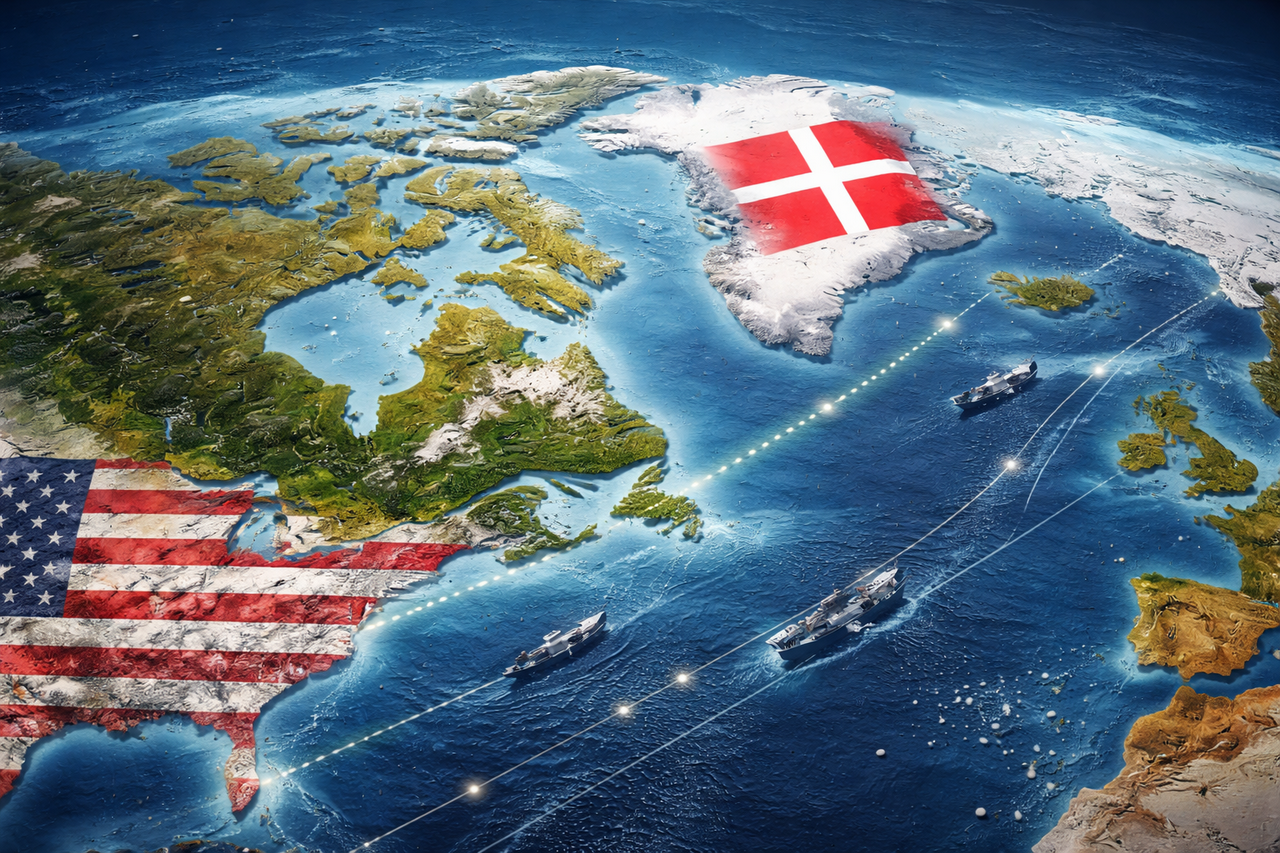
A useful way to understand Washington’s renewed fixation on Greenland is to stop treating it as a quirky real-estate story and start treating it as supply-chain politics; explicitly doctrinal, explicitly hemispheric, and increasingly comfortable with coercive framing and action.
A recent Substack piece by Charlie P. Garcia (“What China Knows About November 10”) is a good example of how this narrative is forming in public: it ties together China’s export-control timing, U.S. industrial constraints, and a political calendar. I don’t agree with every idea in that post, but the core of the argument; “trade war + chokepoints + deadlines = leverage”, is directionally correct and worth taking seriously.
Here’s how I’m seeing things.
The Monroe Doctrine isn’t subtext anymore. It’s printed, and actively followed.
The current U.S. National Security Strategy doesn’t merely nod at hemispheric priority, it explicitly commits to “reassert and enforce the Monroe Doctrine,” framing it as a “Trump Corollary” designed to prevent non-hemispheric competitors from owning or controlling “strategically vital assets” in the hemisphere and to protect access to “key geographies.” (The White House)
This matters because it gives Greenland (and Arctic posture more broadly) a policy container: not “security cooperation,” but “deny rivals control of assets and geography.” When a doctrine names “ownership” and “critical supply chains” in the same breath, it’s not hard to see why minerals become strategic.
The “we already have access” argument is real—and it changes what “control” means.
Under NATO and long-standing U.S.–Denmark arrangements, the U.S. already enjoys meaningful operational access in Greenland. So if the conversation escalates from access to possession—whether rhetorically or politically—it’s fair to ask what the marginal gain is.
In my view, the marginal gain isn’t another runway. It’s investment certainty and supply-chain outcome control:
- permitting pathways and regulatory durability
- infrastructure prioritization (ports, power, water, industrial zoning)
- chain-of-custody confidence for downstream buyers
- “de-risking” capital for processing buildout
That’s what “ownership” buys you in a resources story—whether through literal sovereignty (unlikely and destabilizing) or through quasi-sovereign economic outcomes (concessions, special zones, infrastructure control).
Venezuela is the proof-of-activation problem for anyone still dismissing coercive intent.
If you want to argue that “this is all talk,” you now have to grapple with the fact pattern in Venezuela.
AP’s reporting on the January 22, 2026 war-powers vote is blunt: it describes congressional concern after a surprise U.S. raid to capture Nicolás Maduro and notes that Democrats argued the resolution was necessary “since Trump has stated plans to control the country’s oil industry for years to come.” (AP News)
Whatever your view of legality or wisdom, the political signal is clear: this administration is willing to pursue hemispheric outcomes first and litigate constraints after.
That’s the context in which Greenland rhetoric should be interpreted.
The Greenland story that fits the doctrine is minerals + processing + delivery; not a senile old real estate tycoon wanting a land deal.
To “make Greenland matter” in a trade-war environment, three things must exist simultaneously:
Mining: not just exploration, but permitted, financed production
Processing: separation / metals / magnet-grade manufacturing in a trusted chain (the real chokepoint China dominates)
Delivery: ports and Arctic logistics capable of moving inputs and product reliably
Anything short of that becomes a mock supply chain: “we have resources” without the ability to convert them into industrial output.
This is why the Substack framing resonates: China’s leverage is often downstream, at the point where ore becomes usable industrial inputs. If the objective is to reduce China exposure, Greenland mining alone doesn’t solve it. Processing is the center of the show.
The tech capital angle is not a sideshow; it’s a demand signal, and a political connection.
A key element that political coverage often understates is that rare earths and critical minerals are not only a defense story. They are a compute story.
The Independent reported that tech moguls who invested in Greenland mining also donated heavily to Trump-aligned political efforts, tying the island’s mineral endowment to donor/influence dynamics. (The Independent)
You don’t need conspiracy to see the alignment:
- high-tech demand wants secure, non-China supply
- national security wants non-China supply
- political coalitions want narratives and wins
- “ownership” rhetoric compresses all of that into a single, blunt instrument
Put differently: the tech sector doesn’t need to be “running” policy for its gravity to bend policy.
Putting it all together
If you accept
(a) a stated Monroe Doctrine posture,
(b) a trade-war environment where supply chains are weaponized, and
© a demonstrated willingness to pursue coercive hemispheric outcomes,
then Greenland stops looking like an odd obsession and starts positioning like a target-of-opportunity:
- minerals as leverage
- processing as the bottleneck
- logistics as the enabler
- doctrine as the justification
- tech demand as the accelerant
The practical question isn’t “will the U.S. literally own Greenland.” The practical question is: what instruments will be used to secure ownership-like outcomes such as exclusive access, processing footholds, and durable control of the industrial path from rock to magnet to platform.
That’s the story to watch, and knowing this, Canada can respond appropriately. Ignoring or dismissing this positioning would be a dangerous path.