Understanding Trump's America
As a Canadian, the republican mindset is a bit foreign. I asked some key questions from chatGPT as to where this Republican mindset was coming from and the following research article emerged. I think this is an important read as this perspective is actively and radically reshaping our world and is very foreign to the average Canadian mindset and culture. I believe we really need to pay attention here as this is a significant departure from previous US culture and focus.
Rise of a New Monroe Doctrine: The Road to Trump’s 2025 “Trump Corollary”
Introduction: Revival of the Monroe Doctrine
In December 2025, the Trump administration’s National Security Strategy formally declared a “Trump Corollary to the Monroe Doctrine,” pledging to reassert U.S. dominance in the Western Hemisphere[1]. This marked the culmination of a 15+ year evolution within the American right. The modern Republican Party – influenced by post-Iraq War fatigue, populist nationalism, and great-power rivalry – increasingly embraced a Monroe Doctrine-style outlook that prioritizes the Western Hemisphere over distant global commitments. Under President Donald Trump’s leadership, Republicans resurrected the 1823 doctrine’s core idea with a 21st-century twist: the U.S. claims a special sphere of influence in the Americas, denying foreign powers a foothold and aggressively securing regional interests[1][2]. This report traces how conservative politicians, thinkers, and media voices – reacting to historical events and invoking ideals of “America First” – paved the way for Trump’s 2025 hemispheric strategy.
From Intervention Fatigue to “America First” Nationalism
In the mid-2000s, many Republican voters and emerging leaders grew disillusioned with the interventionist foreign policy that had defined the post-9/11 era. The protracted wars in Iraq and Afghanistan – launched under President George W. Bush’s neoconservative vision of spreading democracy – ended in frustration and high costs. Conservative critics like Pat Buchanan and Ron Paul had long warned that “global hegemony” would overextend America and sap its public support[3]. Their cautions proved prescient. By the 2010s, a significant segment of the American right believed the Iraq War had been a costly mistake, yielding 6,000+ Americans killed and tens of thousands wounded with little to show for it[4][5]. As one retrospective put it, “the American people paid the price… and what was gained? Afghanistan collapsed… Iraq descended into chaos… all while our number one adversary, China, grew in strength”[6]. The sentiment that nation-building “breaks” nations rather than fixes them ran deep[7].
Amid this war fatigue, a new conservative impulse emerged: focus on American national interest at home, rather than utopian missions abroad. Early signs appeared in the Tea Party wave (2009–2010), which primarily fought big government spending but also harbored libertarian and “paleoconservative” skeptics of foreign intervention. Lawmakers like Senator Rand Paul questioned endless wars and surveillance, while writers at outlets like The American Conservative praised a return to a more restrained, “Jacksonian” foreign policy. These ideas remained secondary in the Republican establishment until the rise of Donald Trump, who gave bold voice to them.
Trump’s “America First” Rejection of the Old Order
Donald Trump’s 2016 presidential campaign was a watershed. Breaking with Republican orthodoxy, Trump blasted the Iraq War as “a disaster,” criticized NATO allies for free-riding, and promised to “stop racing to topple foreign regimes” in favor of focusing on America’s borders and jobs. He trumpeted a revival of “American greatness” defined not by global democratic crusades but by economic strength and national sovereignty. In a memorable 2019 address to the U.N., President Trump declared: “The future does not belong to globalists. The future belongs to patriots… to sovereign and independent nations who protect their citizens”[8]. This anti-globalist, pro-sovereignty rhetoric – a hallmark of Trump’s “America First” doctrine – encapsulated a growing conservative conviction that international institutions and endless alliances had eroded U.S. autonomy[9][10].
Trump’s first term (2017–2021) began to translate this vision into policy. He withdrew from or denigrated multilateral agreements (the Paris Climate Accord, the Iran nuclear deal, the Trans-Pacific Partnership) and pressed allies to pay more for their defense. He also confronted China (imposing tariffs and sanctions) and tightened border controls at home. While the 2017 National Security Strategy still spoke of great-power competition, Trump’s instincts were toward retrenchment from “forever wars” and a reorientation of focus toward economic security and the Western Hemisphere. By 2019, senior officials explicitly invoked the Monroe Doctrine in Latin America. National Security Advisor John Bolton, when asked why the administration was taking a hard line against Venezuela’s socialist regime but not other dictatorships, said: “In this administration, we’re not afraid to use the word ‘Monroe Doctrine.’ This is a country in our hemisphere”[11]. He noted it had been U.S. policy since Ronald Reagan to seek a “completely democratic hemisphere,” justifying a hands-on approach in Latin America[11]. Although Bolton himself was a traditional hawk, his rhetoric showed how Trump-era Republicans revived an old principle: problems in the Western Hemisphere would no longer be treated as peripheral but as core security concerns the U.S. must not shy away from.
Concurrently, Congressional Republicans were evolving. Early in Trump’s tenure, there was a split – establishment figures like the late Senator John McCain criticized Trump’s “isolationism,” while a rising “America First” cohort backed him. Over time, the skeptics waned in influence. By the mid-2020s, the GOP had largely absorbed Trump’s worldview. Even traditionally hawkish politicians adjusted their emphasis. For example, Senator Marco Rubio, long an outspoken foe of Latin American leftist regimes, became an enthusiastic architect of Trump’s hemispheric strategy. Tapped as Secretary of State in 2025, Rubio was expected to “bring the Monroe Doctrine back to the center of U.S. foreign policy”[12]. A commentary on his appointment noted Rubio’s unique focus on Latin America and China’s “nefarious activities,” predicting that reasserting the Monroe Doctrine would be his signature contribution[12]. In short, by 2025 even the GOP’s foreign-policy hawks framed their goals – anti-communism, confronting China – in terms of securing America’s backyard first.
Think Tanks and Ideologues: Forging a New Doctrine
The intellectual muscle for this Republican shift was supplied by a network of conservative think tanks and pundits who broke with the post-Cold War consensus. In the 2000s, influential institutions like the Heritage Foundation and American Enterprise Institute (AEI) had largely supported the Bush-era emphasis on free trade, strong alliances, and democracy promotion. But as grassroots sentiment changed, these organizations (to varying degrees) recalibrated around a more nationalist, Monroe Doctrine-friendly outlook:
- Heritage Foundation: By the 2020s, Heritage openly championed Trump’s “America First” agenda. In fact, Heritage’s president Kevin Roberts penned a 2025 manifesto calling for a “foreign policy of realism” that prioritizes U.S. sovereignty and the Western Hemisphere. He explicitly wrote, “Today, we must reassert the Monroe Doctrine… and become the masters of a hemisphere that is peaceful, prosperous, and free from the tired rivalries and conflicts of the Old World.”[13]. Roberts argued that decades of global interventionism had been a “bipartisan delusion” and that “if there was ever a time for revisiting the Monroe Doctrine, we are living in it.”[14]. This marked a stark departure from Heritage’s Reagan-era interventionist streak – now the emphasis was on hemispheric defense, immigration control, and expunging rival powers like China from the Americas[13].
- Claremont Institute: Long focused on America’s founding principles, Claremont became a hub for the new conservative nationalism. Claremont fellows like Michael Anton articulated the Trump Doctrine as a return to founding realist ideas. Anton famously described Trump’s worldview as “anti-imperial” – rejecting global empire in favor of self-interest – and aligned it with early U.S. traditions (citing Washington’s Farewell Address and the Monroe Doctrine)[15][16]. Claremont’s online magazine American Mind amplified arguments that neoconservatism and Wilsonian idealism had failed, and that preserving “faith, family, sovereignty, and ordered liberty” at home must take precedence[7]. The institute’s writers celebrated Trump’s hard line on immigration and championed “Western Hemisphere exceptionalism” – the notion that the New World should chart its own destiny, shielded from Old World entanglements.
- American Enterprise Institute (AEI): AEI harbored internal debates. Some scholars remained staunch advocates of U.S. global leadership. But others acknowledged the new reality. For instance, strategist Colin Dueck argued “Why the Monroe Doctrine Still Matters,” warning that China’s growing influence in Latin America posed a direct threat and validating the need to “deny hostile great powers fresh entry into the Western Hemisphere,” exactly as Monroe had counseled[17]. Historian Hal Brands (also at AEI) observed in 2026 that Trump’s actions – like a bold operation in Venezuela – “serve as proof that [the] Trump’s corollary to the Monroe Doctrine is real,” demonstrating an American willingness to use force in novel ways[18]. While AEI’s establishment did not fully embrace Trumpian populism, it increasingly focused on great-power competition with an appreciation for spheres of influence: even Brands conceded Trump’s NSS implied the U.S. is “more open to spheres of influence” than past strategies[19].
- Hudson Institute: Known for realist and hawkish scholarship, Hudson Institute fellows welcomed the administration’s Western Hemisphere focus. A late-2025 Hudson analysis dubbed “The Return of the Monroe Doctrine” praised Secretary Rubio’s stance, recounting how historically the U.S. had to push out European powers and now faces a “new great power rival in the region: China”, which has become South America’s largest trading partner and even conducted military exercises in the Americas[20]. Hudson experts argued that China’s Belt and Road Initiative in over 20 Latin countries and its espionage presence (e.g. a spy base in Cuba) demand a U.S. response[20][21]. In their view, Trump’s approach simply updated a long U.S. tradition of “keeping hostile powers out of our hemisphere”.
Beyond these institutions, a wider constellation of policy influencers and strategists (many aligned with Trump’s circle) shaped the hemispheric realist ideology. The Center for Renewing America (led by former OMB Director Russ Vought) and the Claremont-affiliated NatCon movement provided policy blueprints stressing immigration enforcement and economic nationalism as security imperatives. By 2024, Heritage and its partners even launched a “Project 2025” to staff a future administration with like-minded personnel – ensuring that the second Trump term would be stocked with Monroe Doctrine adherents rather than Bush-era internationalists.
Conservative Media and Culture: Mainstreaming “Hemispheric Realism”
As Republican elites shifted, conservative media played a pivotal role in selling this new outlook to the base. Fox News, talk radio, and a burgeoning ecosystem of podcasts/Substack newsletters reinforced each other in promoting America First and disparaging “globalist” ideas:
- Fox News Channel: By Trump’s presidency, Fox’s primetime hosts became enthusiastic cheerleaders of his foreign policy instincts. For example, Tucker Carlson frequently questioned U.S. involvement in far-flung conflicts, asking why Washington should defend Ukraine’s border while “our own southern border” was porous. Carlson and others invoked a kind of Monroe Doctrine logic in reverse: they argued that just as Russia fiercely guards its near-abroad (e.g. Ukraine), the U.S. should unapologetically assert control in its neighborhood and not overextend elsewhere. In one debate, Carlson quipped sardonically that “it’s our divine right from God to control our hemisphere,” highlighting how the U.S. would never accept foreign meddling in the Americas even as critics expected America to police the world (his intent was to stress U.S. hypocrisy abroad)[22]. Such segments both reflected and molded GOP base sentiment against funding remote wars (like in Ukraine or Syria) and for a tougher stance at home and in Latin America. Meanwhile, other Fox personalities like Sean Hannity and Laura Ingraham lauded Trump’s confidence to defy “global elites” and take bold action – whether killing terrorists (e.g. Soleimani) or threatening Mexico over drug cartels. By 2025, Fox News openly celebrated the Monroe Doctrine’s return. A Fox op-ed after the Venezuela operation declared: “President [Trump] embraces ‘Donroe Doctrine’ as Venezuela operation leaves Russia and China unable to protect their ally”[23][24]. The network framed Trump’s hemispheric dominance as proof that “America is back” as the “world’s sole superpower”, with no one able to challenge it in its own region[25][24].
- Talk Radio and Podcasts: Conservative talk radio in the 2000s (led by figures like Rush Limbaugh, Mark Levin, and Glenn Beck) had initially supported the War on Terror and Bush’s policies. But as the base opinion shifted, so did they. Limbaugh by the late 2010s echoed Trump’s themes of “secure the border first” and “no more nation-building”. Levin – an instinctive hawk – nonetheless praised Trump’s withdrawal from the Iran deal and Paris accords as affirmations of U.S. sovereignty. New media voices emerged even more stridently. Steve Bannon’s War Room podcast relentlessly pushed economic nationalism and warned of Chinese Communist Party infiltration of American supply chains and even land (raising alarms about Beijing buying farmland in the Americas). Other right-wing podcasts and newsletters on Substack championed “national conservatism” – they linked cultural grievances with foreign policy by arguing that “globalist” policies (mass immigration, international climate agreements, etc.) were eroding America’s cultural fabric and security. For example, the Claremont-aligned American Mind newsletter hosted essays blending culture war and geopolitics, asserting that defending America’s “civilization” requires controlling who and what enters our hemisphere. By amplifying such ideas, conservative media normalized the view that multilateralism, global governance, and open borders are threats, while hemispheric assertiveness is common sense.
- Cultural and Grassroots Voices: The shift also permeated popular conservative culture. Authors like Douglas Murray and Victor Davis Hanson wrote bestselling books criticizing Western Europe’s immigration policies and extolling national sovereignty, reinforcing the Republican focus on defending the home civilization. Meanwhile, grassroots fervor for border security often overlapped with foreign policy – for instance, chants of “Build the Wall!” at Trump rallies were not just about immigration but symbolized a broader desire to withdraw from global entanglements and fortify America’s own realm. Memes and slogans on right-wing social media touted ideas like “no more world policeman” and celebrated Trump’s readiness to “take care of our own backyard”.
This media environment provided constant feedback. Republican politicians took cues from their base’s enthusiasms. When Fox commentators or viral podcast hosts slammed, say, U.S. aid to Ukraine as wasteful “globalism,” GOP lawmakers felt increasing pressure to follow suit. By 2023–24, a significant bloc of Congressional Republicans opposed blank-check aid to Ukraine and instead proposed using the money to bolster the southern U.S. border or even to fight Mexican drug cartels – clear evidence that hemispheric realism had entered Republican mainstream thinking. Senator J.D. Vance and others explicitly argued that fentanyl flowing from Mexican cartels was a more immediate danger to Americans than conflicts in Eastern Europe, aligning with the Monroe Doctrine priority on threats in our hemisphere. In campaign messaging too, Republican candidates touted plans to declare cartels “terrorists” and use U.S. forces against them in Mexico – an extraordinary notion a decade prior, but by 2024 a popular applause line on the right.
Key Catalysts: Events Shaping a Hemispheric Posture
Several major geopolitical events and crises in the past 15–20 years decisively shifted conservative thinking toward the Monroe Doctrine posture:
- Iraq War & Aftermath: The protracted insurgency and failed nation-building in Iraq (2003–2011) bred disillusionment. Conservatives saw that war’s $2 trillion price tag and thousands of lives lost as undermining U.S. strength and morale. The chaos following regime change (rise of ISIS, increased Iranian influence) convinced many that military adventurism only weakened America’s security. This painful lesson inclined Republicans to “restrain our reach” and refocus strategically[7]. It also fed a narrative that global interventions benefitted “globalist” elites or defense contractors while common Americans paid the price.
- Rise of China: As America was bogged down in the Middle East, China was rapidly growing into a peer competitor. By the late 2010s, Beijing’s economic and military expansion became impossible to ignore. Republicans across the spectrum (establishment and Trumpist alike) identified China as the foremost long-term threat – but they differed on response. Trump and his allies emphasized economic decoupling and blocking Chinese influence in the Americas over military commitments in Asia. They frequently pointed out that China was spreading its “tentacles” globally while the U.S. “distracted” itself with ideology-driven wars[26]. Indeed, Beijing’s forays into Latin America – huge infrastructure projects, loans, technology deals, and even security partnerships – served as a wake-up call. It resurrected a classic Monroe Doctrine scenario: a rival great power inserting itself into America’s neighborhood. Republicans cited facts like China becoming the top trading partner of South America and signing Belt & Road deals with over 20 Latin countries[20]. When reports emerged that China had set up a signals intelligence base in Cuba (2019) and was courting leftist governments, the American right reacted sharply. All this reinforced the idea that the Western Hemisphere must be the focus of U.S. strategic defense, both to protect the homeland and to deny China a strategic advantage. Even moderates like Hal Brands noted Trump’s NSS “strongly emphasizes… pushing [China] out of Latin American ports and infrastructure”[27].
- Migration and Border Crises: Few issues connected foreign and domestic policy for conservatives as directly as mass migration. Over the past decade, record numbers of migrants – from Latin America, the Caribbean, even as far as Africa and Asia – have arrived at the U.S.’s southern border, straining resources and provoking political backlash. Republicans view this through a national security lens: uncontrolled migration = eroded sovereignty. “The millions of illegal aliens…are eroding our sovereignty, overwhelming communities… a clear and present threat to our national security,” wrote Kevin Roberts, urging “the first duty of foreign policy is to defend the homeland”[28][29]. Repeated migrant caravans (such as those from Central America in 2018) and the Venezuelan refugee crisis (over 7 million fled Venezuela’s collapse, many heading north[30]) led Republicans to conclude that instability in our hemisphere directly endangers the U.S.. This justified not only tougher border enforcement but also more interventionist approaches regionally to stem the root causes. Trump’s team framed policies like building the border wall, pressuring Mexico to host asylum seekers, and cutting aid to uncooperative Central American governments as part of a broader hemispheric security strategy. By 2025 the National Security Strategy explicitly defined mass migration as the top external threat, above even China or terrorism[31][32]. It argued that Latin America’s role should be preventing any large migrant flows – essentially casting our neighbors as buffer states for U.S. security[31]. This stance – while controversial abroad – resonated strongly with the GOP base’s demand for “border control as national security.”
- Global Supply Shocks (Pandemic): The COVID-19 pandemic (2020–2022) exposed vulnerabilities in global supply chains for critical goods, from medical gear to microchips. For Republicans, it hammered home the dangers of over-reliance on foreign (especially Chinese) manufacturing. Trump had already espoused “economic security is national security,” and the pandemic vindicated that view. Shortages of PPE and medicines made many Americans receptive to bringing supply chains closer to home. The conservative solution emerged as “reshoring” industry or at least “near-shoring” to friendly countries in the Americas. Trump’s 2025 strategy accordingly stressed “reindustrialization” and securing access to critical materials so the U.S. is “never again reliant on any adversary”[33][34]. This economic-nationalist turn reinforced a hemispheric orientation: rather than pursuing global free trade, Republicans began to favor regional trade alignment. They envisioned North and South America (minus hostile regimes) as a secure supply network – for instance, tapping Latin America’s lithium, oil, and rare earth metals for mutual benefit while excluding China. Thus, events like the pandemic shifted GOP thinking toward hemispheric self-sufficiency and skepticism of globalization. As the 2025 NSS put it, the U.S. will “rebalance trade on the basis of mutual benefit and respect… but our priorities must be our own workers, industries, and national security”[35]. This blending of economic and security goals – a fusion of security and economy – is a key tenet of the new Republican doctrine.
- Ukraine War (2022–present): Russia’s invasion of Ukraine initially split Republicans. Traditional security hawks reflexively supported Ukraine, seeing Russia’s aggression as a threat to world order. However, the ascendant MAGA wing questioned prolonged U.S. involvement. Influential conservatives asked why defending Ukraine’s borders was more important than defending America’s borders. Trump himself asserted he could end the war quickly (implying pressuring Ukraine to a deal) and argued Europe should take the lead in its own backyard. Over time, more GOP voters leaned toward this view – polls in 2023–24 showed increasing Republican opposition to blank-check aid for Ukraine, especially as the conflict dragged on. This sentiment dovetailed with Monroe Doctrine reasoning: many on the right felt the U.S. should prioritize challenges in the Americas and East Asia (vis-à-vis China) over a protracted European war. By late 2024, Republican leaders in the House were willing to hold up Ukraine funding, linking it to U.S. border security funding. The contrast was often made explicit: Why secure Kyiv and not Texas? The Ukraine conflict also provided a counterpoint: in conservative media, pundits noted that Putin’s attempt to dominate his “near abroad” (Ukraine) had been thwarted by U.S. support, whereas Trump’s assertion of dominance in our hemisphere (e.g. Venezuela) met little effective resistance[24][36]. Fox News commentary gleefully pointed out that Russia could not save its proxy in Caracas, underscoring that “we can do anything we want in our region, and nobody outside it can stop us”[37][38]. Such comparisons reinforced both the moral (focus on home) and practical (America has unique power in its hemisphere) arguments for the Trump Doctrine.
Taken together, these events forged a consensus on the right that the Western Hemisphere must be the focal point of U.S. foreign policy – for both lofty and practical reasons. Republican strategists began referring to this approach as “hemispheric realism” or “Western Hemisphere First.” It is realist in acknowledging limits (accepting a world of spheres of influence, as Trump’s NSS did by “rejecting the ill-fated concept of global domination” in favor of regional power balances[39][40]). And it is hemispheric-first in asserting the U.S. will expend its will and might primarily where it matters most – along its borders and in neighboring regions – rather than in distant theaters.
The 2025 “Trump Corollary”: Doctrine to Strategy to Action
By President Trump’s second term (beginning January 2025), all these threads were woven into a concrete doctrine. The 2025 National Security Strategy (NSS) devoted unprecedented attention to the Western Hemisphere, enshrining the “Trump Corollary to the Monroe Doctrine” as official policy[1]. This doctrine held that after years of neglect, the U.S. will reassert and enforce the Monroe Doctrine to restore American preeminence in the Western Hemisphere[1]. Practically, it stated: “We will deny non-Hemispheric competitors the ability to position forces or other threatening capabilities, or to own or control strategically vital assets, in our Hemisphere.”[41]. In other words, China, Russia, or any outside power would be categorically barred from military or even significant economic footholds in the Americas. It was a muscular restatement of Monroe’s 1823 warning – updated to include things like critical infrastructure and resources (e.g. ports, 5G networks, mines). The NSS called this “a common-sense and potent restoration of American power and priorities, consistent with American security interests.”[2]
Under this framework, the administration laid out strategies for “enlist and expand” in the Hemisphere[42]. It vowed to enlist regional partners to control migration and cartels, and to expand U.S. influence by bolstering allies’ economies and security – all while making America the Hemisphere’s “economic and security partner of choice.” Key initiatives included:
- Adjusting military posture: “Reconsidering” U.S. global deployments to beef up forces in the Western Hemisphere, e.g. more Coast Guard and Navy assets in Caribbean and Eastern Pacific to interdict drugs and migration, and targeted deployments on land to fight cartels (even using “lethal force to replace the failed law enforcement-only strategy” on the border)[42][43]. In effect, the U.S. started treating transnational cartels as military targets – a significant escalation justified by labeling them narco-terrorists. The Brookings Institution analysis warned that this “insistence that the U.S. military can conduct strikes against ‘cartels’ anywhere in the hemisphere… unleashes a potentially true forever war” and even “contradicts the strategy’s embrace of sovereignty of nations.”[44]. Indeed, Mexico and others bristled at the notion of U.S. strikes on their soil. But to Trump’s aides, power was its own justification – as one supportive commentator put it bluntly, “we took out Maduro because we could… power is its own authority.”[38][45].
- Economic alliance and resource security: The U.S. prioritized “commercial diplomacy” within the Americas – offering tariff deals and investments to counter China’s lure[42]. A major goal was securing access to critical minerals (like lithium in Chile and Bolivia, rare earths, etc.) and energy supplies in friendly hands. The Guardian noted that the “Donroe Doctrine” (as critics dubbed it) was driven in part by “a hunger for minerals” and “hopes of trade advantage” in the region[46]. Trump’s team negotiated agreements for U.S. firms to develop resources in exchange for investment, explicitly to preempt Chinese state companies. The NSS also tied this into reducing migration: helping Latin economies develop (under pro-U.S. governments) would, in theory, “neutralize cartels, near-shore manufacturing, and create stability” so fewer people flee north[42].
- Allies and Pressure: The doctrine was not outright conquest; it spoke of “enlisting partners” and not necessarily demanding ideological alignment. “We must not overlook governments with different outlooks who nonetheless share interests with us,” the NSS suggested[42]. In practice, the Trump administration courted leaders regardless of their democratic credentials as long as they cooperated on U.S. priorities (immigration, Chinese influence, etc.). For example, El Salvador’s populist president Nayib Bukele, despite authoritarian tendencies, became a valued partner for detaining U.S.-bound migrants (a Guardian piece quipped Trump saw the self-described “coolest dictator” as an asset)[47]. Conversely, recalcitrant leaders faced heavy pressure – tariffs, sanctions, election meddling. The administration showed it would play hardball even with nominal allies: in 2025 Trump slapped sanctions on Colombia’s left-wing president and hinted at voiding the USMCA trade pact if Mexico didn’t cooperate on cartels[48][49]. Such moves alarmed many, but they fit the unilateral, might-makes-right ethos of the doctrine. Gunboat diplomacy is back, remarked one observer, as U.S. naval task forces massed off Venezuela’s coast in show of force[50].
The Venezuela Operation (2025) – arguably the “Trump Corollary’s” defining moment – showcased this new posture in action. After years of sanctions and diplomacy failed to oust Venezuela’s anti-American strongman Nicolás Maduro, Trump’s team opted for a dramatic show of force. In late 2025, U.S. special forces launched “Operation Absolute Resolve”, a daring raid in Caracas that deposed and captured Maduro (who was also a Kremlin-aligned leader)[18][25]. The mission stunned the world and had a dual effect: it removed a hostile regime in the U.S.’s near abroad and sent an unmistakable message to rivals. As Bloomberg’s Hal Brands observed, “the daring raid that snagged… Maduro was an awesome display… It serves as proof that Trump’s corollary to the Monroe Doctrine is real”[18]. Indeed, Russia and China – Maduro’s patrons – proved unable to prevent or reverse the U.S. action. They protested loudly but, facing U.S. resolve in its home sphere, essentially had to accept the loss of their proxy. Fox News triumphantly declared that Trump “left no doubt… the United States is still the world’s only superpower, and he just proved it”[51][24]. The op-ed noted neither Putin nor Xi “could do anything to protect their close ally Maduro… in our hemisphere”, validating America’s restored primacy in the New World[52].
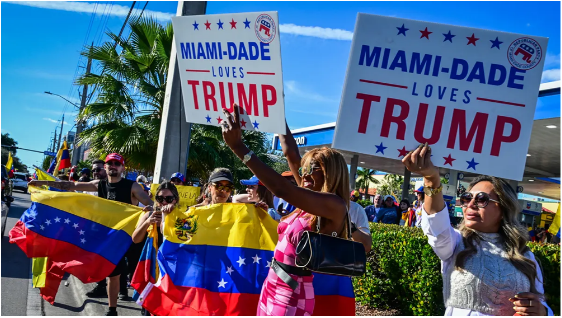
Pro-Trump demonstrators in Florida (many of Venezuelan descent) celebrate after news that a U.S. military operation deposed Venezuela’s Nicolás Maduro, December 2025. The successful ousting of an anti-American regime in the Western Hemisphere was heralded by the right as a triumph of the “Trump Corollary” to the Monroe Doctrine[53][18]._
This Venezuelan episode also highlighted how the new ideology justifies coercive action in the hemisphere. Trump officials framed it not as humanitarian intervention or democracy promotion (though they installed opposition leader Juan Guaidó as interim president afterwards), but as a cold-blooded assertion of national interest and credibility. They argued Venezuela under Maduro had become a “major security threat – a hub for drugs, migration, and Russian-Chinese intrusion – in the U.S. backyard”, thus necessitating action. As one analyst put it, “Trump’s embrace of the Monroe Doctrine… that we have the right and responsibility to control our neck of the geopolitical woods… is proving a raging success”[24]. Administration allies openly eschewed legalistic talk: when critics cited international law, Trump’s supporters scoffed that “in real geopolitics, power is its own authority”[54][38]. This candidly echoes the original Roosevelt Corollary (1904), which held that chronic disorder in the Americas might force the U.S. to intervene as a regional police power. The “Trump Corollary” followed suit, unflinchingly asserting hemispheric hegemony – a stance the right defended as “hard American power setting the guardrails of the globe”[55].
Finally, the 2025 NSS’s tone underscored the cultural-ideological dimension of this doctrine. It spoke of defending the Western world’s heritage and rejected Europe’s recent path, warning of “Europe’s civilizational self-confidence” being lost through mass immigration[56][57]. This mirrored arguments from conservative culture warriors that “Western civilization” was under threat – tying it to both European identity crises and America’s own struggles. Trump’s strategy painted a near-apocalyptic picture of the West (including the U.S.) facing cultural erosion – and pitched his America First, hemisphere-focused policy as part of a civilizational revival. “Mass migration” was cast as a greater threat than state enemies[31]; national borders and cultural cohesion became paramount. This narrative of Western Hemisphere exceptionalism holds that the Americas, led by the U.S., have a special destiny: free from the conflicts of the Old World, provided we keep those conflicts out. It is why Trump felt “unperturbed by Chinese and Russian spheres of influence” in their regions as long as America has “a domain to match Xi’s and Putin’s”[58]. In essence, the U.S. would tolerate a multipolar world with spheres of influence – a break from 1990s unipolarity – but only if the Western Hemisphere was indisputably America’s sphere. This is the grand strategy shift that the Republican Party has now embraced.
Sovereignty, Greatness, and Anti-Globalism: Values Invoked
Underpinning this policy shift are several core values and historical memories repeatedly invoked in right-wing discourse:
- American Sovereignty and Nationalism: The paramount theme is that the U.S. must regain full control of its destiny, unencumbered by global entanglements or institutions. Trump-era conservatives rail against anything perceived to infringe sovereignty – be it U.N. compacts, international law, or even alliances that constrain unilateral action. They echo the Founders’ caution (e.g. Washington’s warning against “permanent alliances”) and celebrate the U.S. Constitution’s primacy over treaties. This veneration of sovereignty is emotionally tied to patriotism – hence Trump’s formulation, “If you want freedom, hold on to your sovereignty… Wise leaders always put their own people first.”[59]. The Monroe Doctrine revival feeds this value: it asserts U.S. sovereign rights in its hemisphere and rejects foreign or “globalist” claims here. It’s often packaged with populist distrust of international elites – e.g. the notion that “globalists” (a term often meaning transnational progressives or bureaucrats) seek to undermine American sovereignty for their own gain. By reasserting a world of competing nations, Republicans position themselves as guardians of American independence and agency.
- “America First” and Greatness: The slogan Make America Great Again was not only domestic but had foreign-policy implications. To many on the right, American greatness had been diluted by decades of globalist policies that expended U.S. blood and treasure for others’ benefits. Reviving the Monroe Doctrine fits the promise of restoring greatness – it harks back to eras when the U.S. was more unchallenged in its region (e.g. the Reagan 1980s or even the early 20th century). There is also a strain of American exceptionalism invoked, but interestingly it’s a nationalist exceptionalism rather than a universalist one. Instead of claiming America must make the world in its image (the neoconservative idea), the new claim is that America’s unique greatness entitles it to lead its hemisphere and set its own rules, free of external interference. Trump’s Fox News boosters explicitly frame it as the U.S. resuming its role as “the only superpower… for the good of all mankind”, implying that a strong America dominating the West is beneficial globally[60][61]. This ties into a quasi-messianic belief that American dominance (at least in the Americas) is stabilizing and righteous, whereas American overreach in foreign lands is self-sabotage.
- Western Hemisphere Exceptionalism: Alongside American patriotism is an old idea made new – that the Western Hemisphere as a whole is a unique sphere, separate from the Old World’s politics. This dates to Monroe’s original message, which cast the Americas’ republican experiments as fundamentally different from Europe’s monarchical intrigues. Modern Republicans echo this by treating the Hemisphere almost as a sanctuary of freedom that must be shielded from outside chaos. In policy terms, it means zero tolerance for extraregional meddling (whether Chinese 5G networks or Russian military advisors). Culturally, it sometimes manifests in Pan-Americanism – cultivating democratic partners in Latin America and celebrating when pro-U.S. leaders win (for instance, conservatives cheered when a pro-market, Trump-friendly candidate won in Argentina’s 2025 midterms, after Trump offered a generous bailout on the condition his ally prevail[47]). Yet it also can verge into neo-imperial paternalism, as critics note: assuming Latin nations are part of an American “family” where Washington is the patriarch. The NSS’s lack of “apology for past U.S. behavior” in Latin America – a point noted by analysts[62] – shows this unapologetic revival of Manifest Destiny attitudes. The administration openly argued that earlier U.S. interventions (from the Cold War and before) were justified in hindsight by the “peace and prosperity” they eventually yielded, and thus there was no need for shame in exercising power now[63]. This is a sharp contrast to the Obama-era approach of acknowledging past U.S. heavy-handedness. Republicans now celebrate that history as necessary realpolitik, consciously invoking Theodore Roosevelt’s “Big Stick” in the region[64].
- Security-Economy Fusion (Mercantilist Realism): A distinctive feature of the new GOP ideology is how national security and economic policy are fused into one. Trade deals, tariffs, energy production, and supply chains are all seen through a security prism. Trump’s policies like steel tariffs (justified on national security grounds), blocking foreign tech (e.g. Huawei) and championing “energy dominance” (maximizing oil & gas output) exemplified this. The principle is that economic independence and strength are prerequisites for military and political power – a view harking back to Hamilton and implemented via industrial policy in the 2025 NSS[33][34]. In the Western Hemisphere context, this means the U.S. seeks to integrate regional economies on its terms (reducing China’s economic leverage) and secure vital resources. Republicans often cite how reliance on Chinese manufacturing or Middle East oil can become strategic vulnerabilities. By contrast, reorienting supply lines to the Americas both safeguards the U.S. and benefits neighbors (making them less inclined to turn to Beijing). It’s a realist, transactional approach: for example, Trump’s people offered Latin nations investments or immigration accords in exchange for aligning with U.S. interests. They also were willing to use coercive economic tools (sanctions, cutting off access to U.S. market) swiftly against hemispheric governments that defied Washington in favor of China or allowed migration flows. In sum, Republicans now view trade and aid not as altruistic or purely market-driven, but as instruments of power – a partial return to the pre-WWII era of spheres-of-influence economics.
- Anti-Globalism and Distrust of Multilateralism: Finally, the Republican embrace of the Monroe Doctrine is deeply intertwined with a rejection of globalism as an ideological foe. In conservative discourse, “globalism” connotes a dilution of national sovereignty through institutions like the U.N., EU, or climate treaties, as well as an elite mindset prioritizing a “one-world” agenda over patriotic loyalties. Trump’s administration was famously hostile to many multilateral bodies – withdrawing from the U.N. Human Rights Council, UNESCO, and criticizing the WTO, while also downplaying NATO and the EU. The Trump Corollary amplifies this ethos: it explicitly sidelines broader international cooperation in favor of ad-hoc coalitions and bilateral deals that the U.S. can dominate. For instance, rather than working through the Organization of American States (OAS) or U.N. to address Venezuela, the U.S. under Trump preferred its own “coalition of the willing” (including willing Latin American allies like Colombia and Brazil under friendly governments). There is also a pronounced contempt for international law in this mindset – as seen when Trump allies dismissed complaints about violating sovereignty or law in Venezuela, calling international law “completely made-up… no American has ever voted for [it]”[65]. This captures the zero-sum, law-of-the-jungle view that many on the right have embraced: might makes right, and global rules only matter if they align with U.S. interests. Far from seeing this as cynical, they couch it in democratic terms – since Americans never consented to global governance, it lacks legitimacy (the reference to “taxation without representation” in rejecting international law[65]). Thus, distrust of multilateralism is both a philosophical stance (national sovereignty first) and a practical one (U.S. freedom of action). It aligns perfectly with a Monroe Doctrine approach in which the U.S. unilaterally defines and defends a sphere, brooking no external veto.
Conclusion: A New Synthesis on the Right
Over the past two decades, the Republican Party’s foreign-policy orthodoxy has undergone a profound transformation. The tragedies and disappointments of the early 21st century – 9/11, Iraq, financial crises, a rising China – bred a hunger for a more focused, hard-nosed American posture, one that prioritizes tangible security and prosperity for U.S. citizens over abstract internationalist goals. In response, conservative leaders and thinkers resurrected elements of an older American strategic tradition (exemplified by the Monroe and Roosevelt Doctrines) and blended them with contemporary nationalist-populist ideas. The result by 2025 is a Republican foreign policy that is unapologetically hemispheric and nationalist: the United States, by dint of history and power, claims a special domain in the Western Hemisphere and will use “hard American power” to keep that domain secure[55].
President Trump’s so-called “Donroe Doctrine” crystallized this orientation. It is characterized by hemispheric exceptionalism (treating the Americas as a unique U.S. sphere), security-economic integration (using trade and energy leverage to bind the region and exclude rivals), and a blunt willingness to use force regionally without multilateral approval. It also comes wrapped in the language of civilizational struggle – defending American culture and the broader West from perceived threats (mass migration, transnational crime, Chinese communist influence, etc.). In many ways, this is a fusion of Jacksonian nationalism with 21st-century geopolitics: it looks inward and westward, not outward and global.
We have seen elected Republicans from Congress to statehouses echo these themes, mirroring their base’s sentiments. Traditional interventionists are increasingly rare in GOP ranks, as the party of Reagan’s “tear down this wall” idealism morphs into the party of “build the wall” literalism. Think tanks have provided the intellectual respectability for this shift, reinterpreting American history and strategy to argue that returning to hemisphere-focused realism is not isolationism but prudence. Conservative media has, in turn, popularized these ideas with a potent mix of fear (of outside threats) and pride (in American strength).
Of course, this new doctrine is not without its controversies and risks. Latin American nations have reacted with wariness or outright hostility to Washington’s more coercive approach – many remember the Cold War interventions and resent a revival of Yankee assertiveness. Even some U.S. analysts warn that “the overarching framework of a ‘Trump Corollary’ is counterproductive, given the bitter legacy of U.S. intervention in the region”[66]. They argue cooperation on shared challenges could be smoother without the whiff of imperialism. Additionally, by de-emphasizing multilateral alliances and values, the U.S. may be seen as abdicating global leadership, potentially emboldening adversaries elsewhere.
Yet, within the Republican Party and conservative movement, the consensus appears durable: after decades of global overreach and perceived drift, America will tend its own garden first. That means securing the homeland, asserting control of the surrounding neighborhood, and dealing with great-power rivals from a position of regional strength. The modern GOP now invokes the Monroe Doctrine much as it once did anti-communism – as a guiding star. In a sense, it is a return to fundamentals: as James Monroe and John Quincy Adams argued 200 years ago, the safety and prosperity of the United States are inextricably tied to keeping the Western Hemisphere free from hostile influence. Today’s Republicans have rediscovered that principle and adapted it for the 21st century, reasserting what they see as America’s rightful preeminence in the New World – and, by extension, a rebalanced American role in the world at large[67][64].
Sources: The analysis above draws on the 2025 U.S. National Security Strategy and commentary around it, including the strategy’s own language on the “Trump Corollary”[1], think-tank interpretations (e.g. Brookings’ critique of its “neo-imperialist presence” in Latin America[62]), statements by officials like John Bolton[11], and conservative media perspectives celebrating the new doctrine (Fox News, The American Mind, etc.)[24][13]. These sources collectively illustrate the Republican Party’s ideological journey and the convergence of political, intellectual, and popular forces that produced the modern Monroe Doctrine-style orientation.
[1] [2] [33] [34] [35] [41] [42] whitehouse.gov
https://www.whitehouse.gov/wp-content/uploads/2025/12/2025-National-Security-Strategy.pdf
[3] [4] [5] [6] [7] [9] [10] [13] [14] [15] [16] [26] [28] [29] A Foreign Policy for America’s Golden Age – The American Mind
https://americanmind.org/memo/a-foreign-policy-for-americas-golden-age/
[8] [59] Remarks by President Trump to the 74th Session of the United Nations General Assembly – The White House
[11] John Bolton: 'We're not afraid to use the word Monroe Doctrine'
[12] [20] [21] [30] Rubio and the Return of the Monroe Doctrine | Hudson Institute
https://www.hudson.org/foreign-policy/rubio-return-monroe-doctrine-mike-watson
[17] Why the Monroe Doctrine Still Matters | American Enterprise Institute
https://www.aei.org/research-products/report/why-the-monroe-doctrine-still-matters/
[18] A US Venezuela Victory May Help China Gain an Edge | Capt.(Dr.) S G Naravane
[19] [27] [31] [32] [39] [40] [44] [56] [57] [62] [63] [66] Breaking down Trump’s 2025 National Security Strategy | Brookings
https://www.brookings.edu/articles/breaking-down-trumps-2025-national-security-strategy/
[22] Tucker Carlson & John Mearsheimer: The Monroe Doctrine & Ukraine
[23] [24] [25] [36] [37] [38] [45] [51] [52] [53] [54] [55] [60] [61] [65] President Donald Trump Venezuela operation deposes Nicolas Maduro | Fox News
https://www.foxnews.com/opinion/david-marcus-trump-restores-america-worlds-sole-superpower
[43] [46] [47] [48] [49] [50] [58] [64] [67] The Guardian view on the new Monroe doctrine: Trump’s forceful approach to the western hemisphere comes at a cost | Editorial | The Guardian