Watching Definitions Drift:
A Canadian View on Free Speech, DEI, and “Terrorism”
As Canadians we often look south and assume the turbulence of American politics stays there. But definitions do not stop at borders. What gets redefined in Washington or state capitals can spill into cross-border companies, influence Canadian debate, and reshape expectations here.
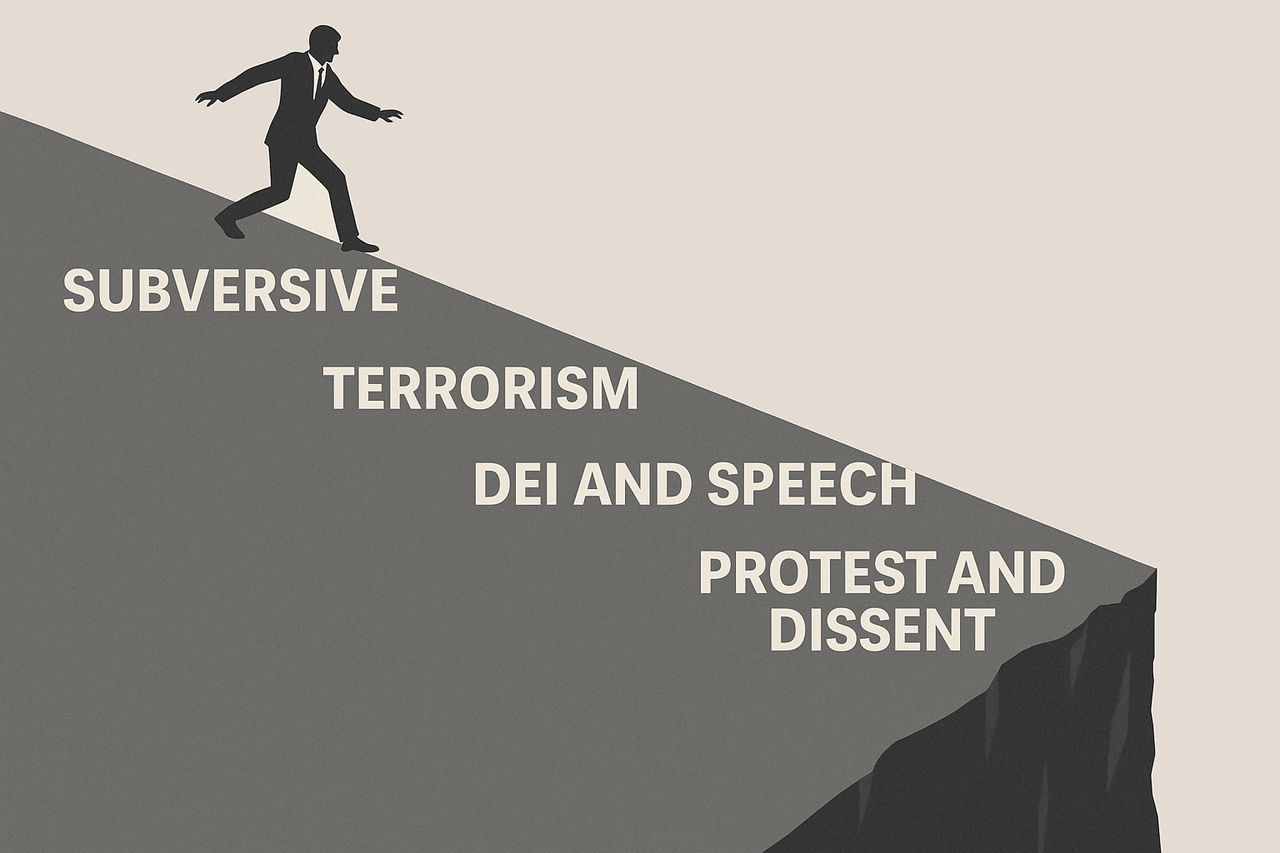
In the United States, we are seeing how words like subversive, terrorism, and even DEI are being redefined. Each shift might look small in isolation, but over decades they add up. The pattern is consistent: broaden the definition, expand the executive’s tools, narrow the space for dissent.
Awareness is necessary.
A History of Redefinition
- Cold War (1950s): “Subversive” once meant plotting violent overthrow. By the mid-century it included political parties, activists, and unions. Membership itself, not actions, became grounds for sanction.
- Post-9/11 (2001): “Material support for terrorism” expanded beyond weapons or funds. Translation, charity donations, or association could be treated as terrorism. Courts largely deferred to the executive’s definitions.
- Cyber era (2010s): Criminal acts like ransomware or infrastructure attacks began to be discussed as terrorism. Profit-driven crime blurred into politically motivated violence in public discourse.
Each redefinition added tools to the executive branch while reducing space for dissent or ambiguity.
The Present: Universities, DEI, and Speech
Now we see the same mechanism applied domestically.
- DEI programs recast as harmful and illegal. Several states have moved to shut down DEI offices, bar diversity statements in hiring, or ban certain campus programs. The University of Michigan and the University of Virginia recently closed DEI offices under political and financial pressure. The DOJ states “Diversity, equity and inclusion practices are unlawful and ‘discriminatory.’”
- Licensing and accreditation as levers. Commentators and policymakers are suggesting that speech by professionals such as lawyers, teachers, even comedians could risk licenses or accreditation if deemed offensive or out of line. A recent example is FCC Chair Brendan Carr has indicated interest in using licensing authority / public interest enforcement to address broadcaster content he considers biased. The US Attorney General stated “…free speech and then there’s hate speech, and there is no place, especially now, especially after what happened to Charlie, in our society” spoken by U.S. Attorney General Pam Bondi, in reference to speech content seen in the wake of the Charlie Kirk killing.
- Chilling institutional speech. Government letters to universities have demanded information about whether DEI is still taught, with warnings that association could affect eligibility for clerkships or grants.
In Canada, DEI remains embedded in employment equity and human rights law. But Canadian subsidiaries of U.S. companies are adjusting to American restrictions, and those shifts spill north. What is defined as “risky” in the U.S. often becomes risky here.
The Next Step: Cartels as Terrorists
In January 2025, an Executive Order designated cartels as “terrorist organizations.” Drug gangs are brutal criminal networks, but their aim is profit, not ideology. By treating them as terrorists, the government expands its terrorism toolkit—sanctions, interdiction powers, broader surveillance—into the criminal space.
This is legally modest but conceptually significant. It continues the slope: once “terrorism” applies to profit-driven crime, what prevents it from being applied next to protest groups or ideological movements?
The Slippery Slope Trajectory
The sequence is visible across decades:
Broaden “subversive” (1950s) to silence political groups.
Broaden “terrorism” (2001) to capture support activity.
Broaden again (2010s) to include cybercrime.
Reframe DEI and institutional speech (2020s) as suspect or harmful.
Redefine organized crime (2025) as terrorism.
Future risk: Extend terrorism labels to protest, dissent, or ideological opposition.
Immigration law in the U.S. already shows how dissent and opposition groups are reclassified as terrorism for administrative purposes. In a sense the “future” is already here, reflected in immigration reality.
Why Canadians Should Care
- Cross-border pressure. Canadian subsidiaries and institutions adjust when U.S. parent companies change policies.
- Legal precedent. Once the U.S. normalizes these definitions, Canadian policymakers may echo them.
- Cultural influence. Canadian public debate often follows U.S. framing, even before Canadian law does.
Validation Checklist: Signs Definitions Are Shifting
Executive or legislative redefinitions
- Track when terms like terrorism, subversive, divisive topics, or unproven theories appear in new orders or bills.
- Ask: is the scope wider than before?
Licensing or accreditation linked to speech
- Watch for professional bodies (law, teaching, medicine) or universities tying licenses, contracts, or recognition to specific viewpoints.
Funding conditions
- Monitor whether federal or state grants, contracts, or research funding are conditioned on ideological alignment or exclusion of certain topics.
Judicial deference
- Note if courts uphold broad executive definitions without strict review. This is often where temporary redefinitions become precedent.
Rhetorical escalation
- Pay attention when dissent or protest is described in political speeches as extremism, terrorism, or foreign influence. The rhetorical shift usually comes before legal codification.
A Call to Awareness
As Canadians we cannot assume our safeguards will hold without vigilance. The lesson from watching our neighbours is not panic, but awareness and to refocus our messaging to respecting democracy and freedom. Each definitional shift narrows the boundaries of legitimate dissent. By tracking those shifts early, we keep space open for disagreement—the oxygen of democratic societies.
note: Ran across this recently
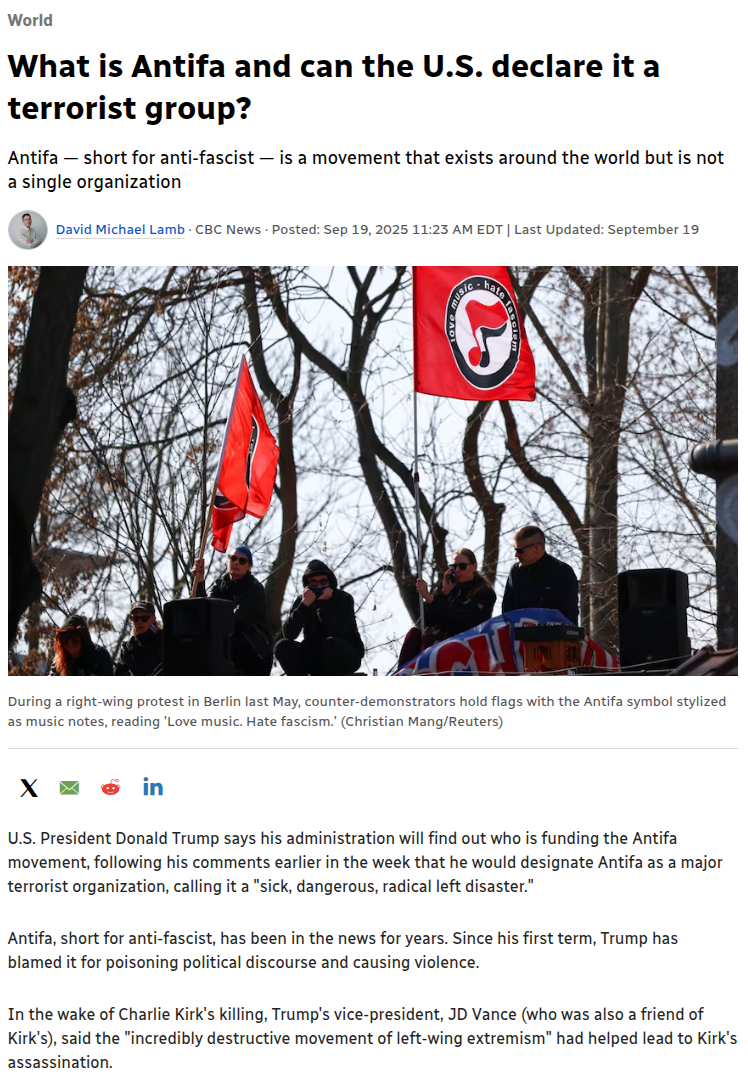
https://www.cbc.ca/news/world/antifa-trump-kirk-terrorism-1.7637554