Thoughts and Musings

Articles that defy the categories of my other blogs

Populist-authoritarian drift tracker (2005 to 2025)

Baseline context for the last 20 years

Freedom House describes 2024 as the 19th consecutive year of global freedom decline, citing election manipulation, political violence, armed conflict, and deepening repression as major drivers. V-Dem’s Democracy Report 2025 frames the same period as a deepening “third wave” of autocratization, including weakening in established democracies and consolidation in already backsliding states.

Sources: https://freedomhouse.org/article/new-report-amid-unprecedented-wave-elections-political-violence-and-armed-conflict-fueled https://v-dem.net/documents/54/v-demdr2025lowresv1.pdf


Stage 1: Power achieved

Hungary (Fidesz under Viktor Orbán)

Hungary is an example of a movement that achieved power and then made democratic competition less fair in practice. Freedom House rates Hungary “Partly Free” in 2025. Freedom House OSCE/ODIHR’s final report on Hungary’s 2022 parliamentary election documents systemic conditions that advantaged the governing party, including the overlap between government messaging and ruling party campaigning, which is a classic operational marker of democratic tilt toward one-party dominance. OSCE

Printed sources: https://freedomhouse.org/country/hungary/freedom-world/2025 https://www.osce.org/sites/default/files/f/documents/2/6/523568.pdf

Turkey (Erdoğan-aligned governing bloc)

Turkey is a mature case of executive consolidation. Freedom House rates Turkey “Not Free” in 2025. Freedom House The U.S. State Department’s 2024 human rights report describes serious restrictions on freedom of expression and media freedom, including arrests and prosecutions of journalists and censorship, which are operational enablers for authoritarian control because they reduce independent scrutiny and constrain opposition organization. State Department

Printed sources: https://freedomhouse.org/country/turkey/freedom-world/2025 https://www.state.gov/reports/2024-country-reports-on-human-rights-practices/turkey/

India (BJP under Modi)

India is a case where power is achieved and the key question becomes the direction of institutional constraints. Freedom House rates India “Partly Free” in 2025 and notes a decline in score from the previous year. Freedom House In a drift model, the operational indicators to watch are pressure on civic space and the press, and the use of state institutions in ways that raise the cost of opposition coordination or independent reporting.

Printed sources: https://freedomhouse.org/country/india/freedom-world/2025 https://v-dem.net/documents/54/v-demdr2025lowresv1.pdf

Slovakia (Fico-led coalition)

Slovakia is a recent-cycle case where changes to the information environment and civic space are prominent. UN independent experts warned in March 2025 about deterioration of fundamental freedoms, including pressure on NGOs and the media, and alleged use of surveillance systems for political repression. OHCHR Slovakia’s contested public broadcaster changes were widely reported as raising concerns about political control of public media, which is a common early mechanism for durable authoritarian influence. Euractiv

Printed sources: https://www.ohchr.org/en/press-releases/2025/03/experts-alarmed-deterioration-fundamental-freedoms-and-civic-space-slovak https://www.euractiv.com/news/slovak-parliament-approves-governments-contested-public-broadcaster-revamp/

Netherlands (PVV as coalition partner, short-lived executive leverage)

The Netherlands is better framed as “agenda stress” rather than classic institutional capture. In 2024 to 2025, the PVV entered a governing coalition, and the coalition later collapsed amid conflict over asylum and immigration policy. Financial Times+1 In a drift model, the signal here is whether hardline demands translate into durable changes to administrative practice or legal constraints, even after a coalition fails.

Printed sources: https://www.ft.com/content/5d92c5f4-c064-4143-890d-ddb7d288ad16 https://www.aljazeera.com/news/2025/6/4/why-did-the-dutch-government-collapse-and-whats-next

United States (populist-nationalist executive, 2025 policy markers)

If you are tracking movement away from multilateral-democracy posture into sovereignty-first retrenchment as a structural indicator, the February 4, 2025 executive order directing a review of treaties and international organizations is a concrete marker. The White House+1 In a broader drift model, the operational question is whether institutional constraints and rule-of-law norms hold under sustained political pressure, which is exactly the type of risk V-Dem’s autocratization framing is designed to measure at scale. V-Dem

Printed sources: https://www.whitehouse.gov/presidential-actions/2025/02/withdrawing-the-united-states-from-and-ending-funding-to-certain-united-nations-organizations-and-reviewing-united-states-support-to-all-international-organizations/ https://www.govinfo.gov/content/pkg/DCPD-202500222/pdf/DCPD-202500222.pdf https://v-dem.net/documents/54/v-demdr2025lowresv1.pdf

Poland (PiS, within the 20-year window)

Poland is a useful “within-window” reference case because it illustrates how backsliding can occur during a period of governance and still leave institutional after-effects after turnover. Freedom House rates Poland “Free” in 2025, but the drift discussion remains relevant because the pathway often runs through judiciary, oversight bodies, and media governance. Freedom House+1

Printed sources: https://freedomhouse.org/country/poland/freedom-world/2025 https://v-dem.net/documents/54/v-demdr2025lowresv1.pdf


Stage 2: Strong, trackable influence achieved

Germany (AfD as a major parliamentary force)

Germany is a clean example of influence without executive control. Official federal results for the 2025 Bundestag election show AfD at roughly one-fifth of the vote, making it a structural agenda setter even if coalition “firewalls” hold. Bundeswahlleiterin In drift terms, the operational signals are normalization (informal cooperation), rights restrictions justified as “security exceptions,” and administrative enforcement changes that outlast one parliament.

Printed sources: https://bundeswahlleiterin.de/en/bundestagswahlen/2025/ergebnisse/bund-99.html

France (National Rally as a large bloc in a hung parliament)

France demonstrates how influence can operate through bloc size and deadlock. The Interior Ministry provides definitive results for the 2024 snap legislative election. Ministère de l'Intérieur In drift terms, the risk is less about immediate capture and more about whether repeated gridlock drives shortcuts, emergency-style governance, or durable shifts in what policies become politically mandatory.

Printed sources: https://www.interieur.gouv.fr/actualites/actualites-du-ministere/elections-legislatives-2024-resultats-definitifs

Sweden (Sweden Democrats shaping priorities through cooperation)

Sweden’s case is direct “influence architecture.” The Swedish government states that governing parties cooperate with the Sweden Democrats across multiple priority areas. Regeringskansliet In drift terms, the operational indicator is whether policy influence expands state surveillance, data-sharing, or enforcement posture in ways that persist regardless of which party formally holds the premiership.

Printed sources: https://www.government.se/articles/2022/11/the-governments-political-priorities/


Europe-wide baseline drift (authoritarian-populist vote share)

For Europe, the Timbro Authoritarian Populism Index provides a measurable, cross-country view of sustained vote share for parties it categorizes as illiberal and authoritarian in orientation. This is a practical “early warning” layer because it captures when support becomes durable enough to pressure mainstream platforms before formal power is achieved. EPICENTER

Printed sources: https://www.epicenternetwork.eu/wp-content/uploads/2024/04/Populism-Index-2024-Compressed.pdf


There is an assumed underpinning in our culture that media drives our messages and meaning. Since Marshall McLuhan’s theory shifted attention toward technology as the key influence shaping communication, we have gradually surrendered the sense that storytelling is a human act of choice. A deterministic philosophy has taken root, one that treats structure and system as autonomous forces, replacing the storyteller’s agency with technical inevitability.

We have placed our cultural agency into our tools. Technical design, rather than human intention, now dominates our social coherence. Every tool, from the most intricate circuit to the interface of a mobile app, is a human creation. Yet we often forget that these technologies are not the story; they are instruments for telling one.

McLuhan was right that the structure of our tools shapes experience more than we often realize. But extending that insight into full determinism goes too far. The danger lies in mistaking influence for control. Structure can guide, but it does not dictate.

This distinction is not academic. As the pace of technical innovation accelerates, our excitement and ambition often exceed our reflection. We are building at unprecedented speed, without equal attention to what our creations do to our sense of intimacy, authenticity, and shared discovery. In chasing the next breakthrough, we risk becoming the experiment; Frankenstein’s creators looking for life in the machine rather than meaning in ourselves.

It is time to reverse the lens. Technology should not be the driver of our human story. We must reclaim creative agency; storytelling with purpose, design with moral and social intent, creation with reflection. McLuhan taught that the medium shapes the message. Today, the correction must be that we shape the medium.

If we do not restore this balance, our tools will continue to speak louder than we do. Before it is too late, we need to take responsible ownership of our technologies, heal our fractured relationship with creation, and let our mediums once again serve our story.

A Call to Move Beyond Despair and Reclaim Meaning

We are living through a period not marked by a lack of information, but by a lack of meaning. Rising levels of anxiety, depression, and isolation are most visible among young people, but it would be a mistake to see this only as a youth problem. It is a broader cultural signal. When a generation loses confidence in basic direction—what a good life is, what adulthood requires, what we owe one another—mental distress becomes the language through which that uncertainty is expressed.

It is tempting to point to social media, algorithms, or smartphones as the cause. These tools clearly intensify comparison, distraction, and isolation. But they did not create the conditions into which they entered. They found a society already unmoored from shared values and common frameworks. The phone did not remove meaning; it filled the vacancy left when families, schools, civic institutions, and communities stopped transmitting it. We handed a generation unlimited freedom without orientation and then wondered why they feel lost.

The deeper issue is not technology. It is the erosion of moral and civic horizons that once helped people locate themselves in a larger story. We have shifted from a culture that formed individuals through shared expectations to one that leaves individuals to invent meaning on their own. Identity is no longer shaped through commitment or responsibility but through self-expression and performance. Without any shared reference points—duty, virtue, service, truth—each person becomes their own project, yet without tools to complete it.

The result is not greater freedom. It is exhaustion. Many young people are not rejecting meaning; they are searching for it and struggling to find it. Adults are not immune. Across all ages, people retreat into distraction, consumer habits, or tribal loyalties because no trusted frameworks remain to guide conviction. This is why despair feels ambient. It is not only personal; it is structural.

When a culture abandons shared moral frameworks, it does not create neutrality. It creates a vacuum. Vacuums are never stable. When truth and responsibility are no longer credible guides, power fills the space. Influence replaces principle. Loudness replaces authority. In such conditions, people will accept control in exchange for certainty. Authoritarianism does not always announce itself through force. It grows through resignation—when people no longer believe a common good can be named or pursued.

This is why the mental health crisis and the civic crisis cannot be separated. A society unsure of its moral direction produces individuals unsure of their worth and purpose. Without meaning, freedom becomes insecurity. Without shared values, disagreement becomes conflict. Without a vocabulary for the good, persuasion gives way to coercion.

The task ahead is not to return to a single worldview or impose uniform belief. It is to recover a language capable of supporting reflection, responsibility, and shared life. A society need not agree on every conclusion, but it must agree that certain questions matter: What is a life for? What virtues are worth cultivating? What do we owe to those who come after us? These questions once lived inside institutions. If those institutions no longer give answers, we must rebuild them or replace them with ones that can.

This will require new forms of dialogue—dialogue that is not debate. Debate aims to win. Dialogue aims to understand. Debate produces positions. Dialogue produces responsibility. If we cannot speak across differences about what is worth preserving, we will continue to live in reaction rather than purpose.

Those who work in education, community leadership, faith, health, and governance cannot wait for cultural clarity to arrive from elsewhere. This work falls to us. The environments we build—classrooms, households, public forums, mentorship spaces—must once again take seriously the formation of character, not just the transfer of knowledge. Without formation, knowledge turns cynical or performative. Young people do not need more content. They need encounters with commitment, belonging, and direction.

The opposite of despair is not optimism. It is purpose. Hope is not a feeling. It is a course of action. We cannot promise ease to any generation, but we can offer the tools to build a life that holds together. We can show that suffering is not a dead end when it is attached to meaning. We can make clear that freedom is not the absence of obligation but the discovery of the right obligations.

If we do not offer meaning, people will accept domination. If we do not seek common ground, we will be ruled by division. The question is not whether a society will be guided by values, but which values it will choose—integrity and responsibility, or influence and control.

We are at a point where silence becomes consent to further fragmentation. The search for meaningful dialogue is not a call to sentiment. It is a call to rebuild the conditions under which people can live with purpose and togetherness. It asks us to speak of the good without embarrassment, to model seriousness without dogma, and to accept that the health of our society depends on more than personal choice.

The young are not asking for protection from the world. They are asking for a world that is worth entering. To build such a world, we must recover the willingness to name what is worth living for, and to do so in common.

A Canadian View on Free Speech, DEI, and “Terrorism”

As Canadians we often look south and assume the turbulence of American politics stays there. But definitions do not stop at borders. What gets redefined in Washington or state capitals can spill into cross-border companies, influence Canadian debate, and reshape expectations here.

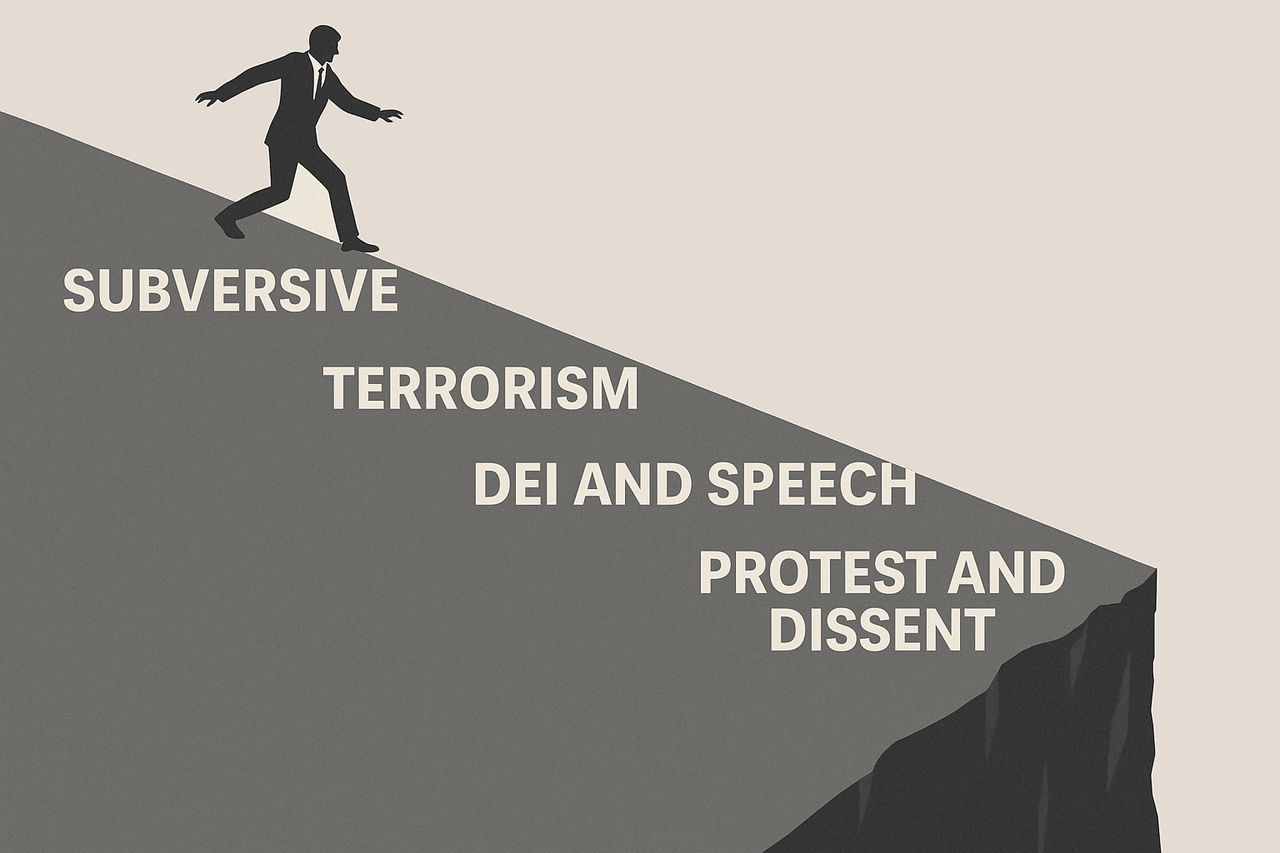
In the United States, we are seeing how words like subversive, terrorism, and even DEI are being redefined. Each shift might look small in isolation, but over decades they add up. The pattern is consistent: broaden the definition, expand the executive’s tools, narrow the space for dissent.

Awareness is necessary.

A History of Redefinition

  • Cold War (1950s): “Subversive” once meant plotting violent overthrow. By the mid-century it included political parties, activists, and unions. Membership itself, not actions, became grounds for sanction.
  • Post-9/11 (2001): “Material support for terrorism” expanded beyond weapons or funds. Translation, charity donations, or association could be treated as terrorism. Courts largely deferred to the executive’s definitions.
  • Cyber era (2010s): Criminal acts like ransomware or infrastructure attacks began to be discussed as terrorism. Profit-driven crime blurred into politically motivated violence in public discourse.

Each redefinition added tools to the executive branch while reducing space for dissent or ambiguity.

The Present: Universities, DEI, and Speech

Now we see the same mechanism applied domestically.

  • DEI programs recast as harmful and illegal. Several states have moved to shut down DEI offices, bar diversity statements in hiring, or ban certain campus programs. The University of Michigan and the University of Virginia recently closed DEI offices under political and financial pressure. The DOJ states “Diversity, equity and inclusion practices are unlawful and ‘discriminatory.’”
  • Licensing and accreditation as levers. Commentators and policymakers are suggesting that speech by professionals such as lawyers, teachers, even comedians could risk licenses or accreditation if deemed offensive or out of line. A recent example is FCC Chair Brendan Carr has indicated interest in using licensing authority / public interest enforcement to address broadcaster content he considers biased. The US Attorney General stated “…free speech and then there’s hate speech, and there is no place, especially now, especially after what happened to Charlie, in our society” spoken by U.S. Attorney General Pam Bondi, in reference to speech content seen in the wake of the Charlie Kirk killing.
  • Chilling institutional speech. Government letters to universities have demanded information about whether DEI is still taught, with warnings that association could affect eligibility for clerkships or grants.

In Canada, DEI remains embedded in employment equity and human rights law. But Canadian subsidiaries of U.S. companies are adjusting to American restrictions, and those shifts spill north. What is defined as “risky” in the U.S. often becomes risky here.

The Next Step: Cartels as Terrorists

In January 2025, an Executive Order designated cartels as “terrorist organizations.” Drug gangs are brutal criminal networks, but their aim is profit, not ideology. By treating them as terrorists, the government expands its terrorism toolkit—sanctions, interdiction powers, broader surveillance—into the criminal space.

This is legally modest but conceptually significant. It continues the slope: once “terrorism” applies to profit-driven crime, what prevents it from being applied next to protest groups or ideological movements?

The Slippery Slope Trajectory

The sequence is visible across decades:

  1. Broaden “subversive” (1950s) to silence political groups.

  2. Broaden “terrorism” (2001) to capture support activity.

  3. Broaden again (2010s) to include cybercrime.

  4. Reframe DEI and institutional speech (2020s) as suspect or harmful.

  5. Redefine organized crime (2025) as terrorism.

  6. Future risk: Extend terrorism labels to protest, dissent, or ideological opposition.

Immigration law in the U.S. already shows how dissent and opposition groups are reclassified as terrorism for administrative purposes. In a sense the “future” is already here, reflected in immigration reality.

Why Canadians Should Care

  • Cross-border pressure. Canadian subsidiaries and institutions adjust when U.S. parent companies change policies.
  • Legal precedent. Once the U.S. normalizes these definitions, Canadian policymakers may echo them.
  • Cultural influence. Canadian public debate often follows U.S. framing, even before Canadian law does.

Validation Checklist: Signs Definitions Are Shifting

  1. Executive or legislative redefinitions

    • Track when terms like terrorism, subversive, divisive topics, or unproven theories appear in new orders or bills.
    • Ask: is the scope wider than before?
  2. Licensing or accreditation linked to speech

    • Watch for professional bodies (law, teaching, medicine) or universities tying licenses, contracts, or recognition to specific viewpoints.
  3. Funding conditions

    • Monitor whether federal or state grants, contracts, or research funding are conditioned on ideological alignment or exclusion of certain topics.
  4. Judicial deference

    • Note if courts uphold broad executive definitions without strict review. This is often where temporary redefinitions become precedent.
  5. Rhetorical escalation

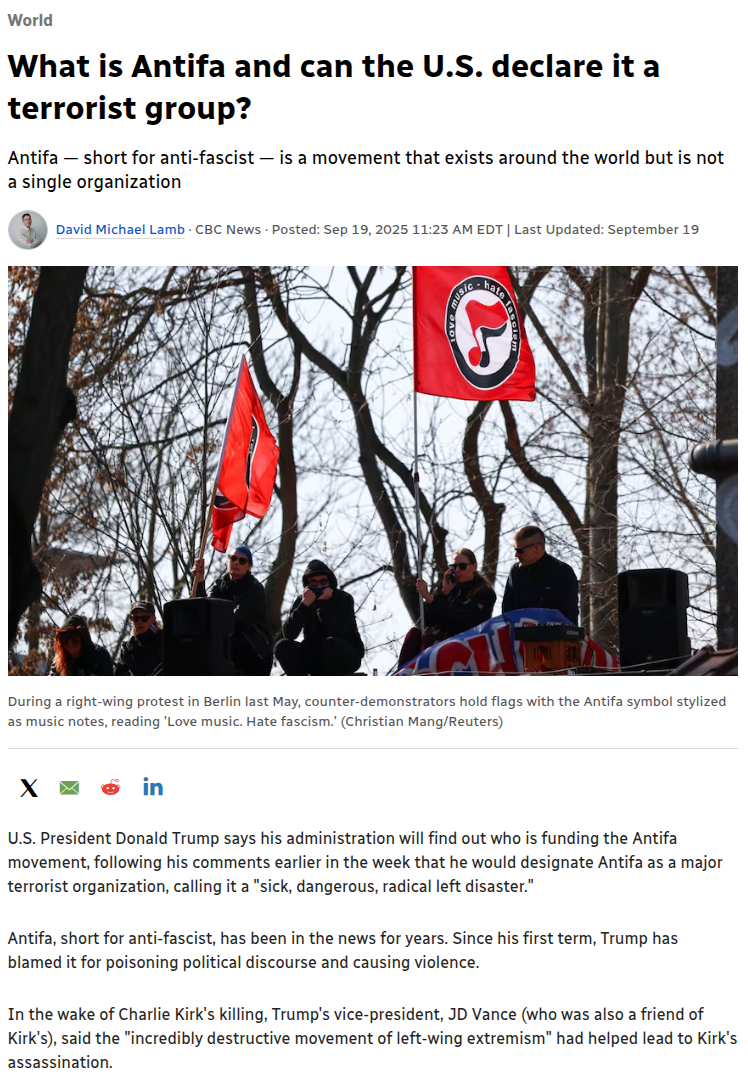
    • Pay attention when dissent or protest is described in political speeches as extremism, terrorism, or foreign influence. The rhetorical shift usually comes before legal codification.

A Call to Awareness

As Canadians we cannot assume our safeguards will hold without vigilance. The lesson from watching our neighbours is not panic, but awareness and to refocus our messaging to respecting democracy and freedom. Each definitional shift narrows the boundaries of legitimate dissent. By tracking those shifts early, we keep space open for disagreement—the oxygen of democratic societies.

note: Ran across this recently

https://www.cbc.ca/news/world/antifa-trump-kirk-terrorism-1.7637554

Are we seeing the rise of a new dystopia of our own creation?

Alex DiMarco

March 30, 2025

Are we living between two warnings? Is disconnection, distraction, and the loss of a shared reality creating a growing sense that something isn’t right?

We seem to live in a time when truth feels negotiable, where outrage moves faster than understanding, and where attention—our most personal and precious resource—is constantly under siege. We’ve come to expect immediacy, certainty, and stimulation. And yet, many of us feel more disconnected, more anxious, and more unsure than ever.

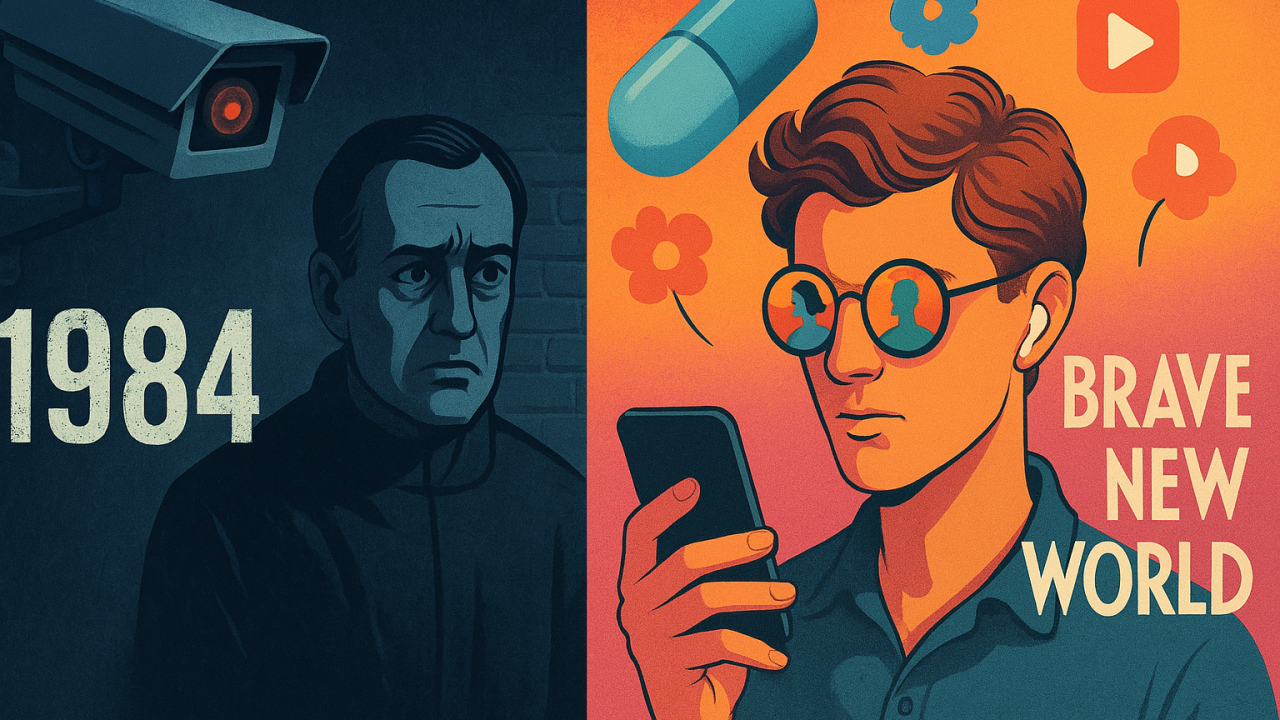
It’s hard not to see echoes of both Orwell and Huxley in this moment.

Orwell warned of control through fear, through the manipulation of truth and the pressure to conform. Today, disinformation flows through political messaging, social media feeds, and even casual conversations—shaping perception faster than we can fact-check it. Trust in institutions, journalism, and even in each other is thinning. Truth is still there, but it often gets buried beneath repetition and noise. Often our temptation is to follow the group rather than to question or seek truth which is becoming more difficult to discover and discern.

But Huxley’s warning feels just as present, if not more so. He feared we would be lulled into passivity not by force, but by pleasure. That we would be too distracted to notice what we were losing. The constant scroll of content, the curated lives we see online, the dopamine-driven design of our digital tools—it’s all designed to keep us engaged, but not necessarily connected. We seem to be lulled into accepting the illusion of connection rather than the reality of it, pursuing goals that are reinforced by algorithms that are programmed to growing company profits rather than our own personal choice or collective dialogue.

Psychiatrists, educators, and technologists are raising concerns about what this means, while political and social messaging works to discredit their perspectives into just another noisy opinion. Our attention spans are shrinking. Our ability to sit with discomfort, to focus deeply, and to empathize with others is fraying. The emotional distance this creates is subtle, but real. We’re present, but not really here. We hear, but we don’t always listen. We run away from conflict rather than participate in seeking truth or justice. We connect online speaking our minds – often without filtering – but fear personal interaction and real-world conversations.

And in this space, where confusion meets distraction, we lose something essential—not just the clarity of truth, but the quality of our relationships, seeking comfort in distraction rather than engagement.

This isn’t just a political or technological issue. It’s a relational one that hits the very core of who we are. How do we hold onto empathy in a world designed to fracture our focus? How do we stay grounded in meaningful relationships when we’re constantly nudged toward division, speed, and surface-level thinking?

The answer may not be fast or easy. But perhaps it starts with recognizing that how we pay attention matters and how we relate to others is crucially important. That truth and trust are not just intellectual concerns—they are emotional and relational ones. That “cancelling” each other out or bullying into compliance are both relational failures that lead to collective destruction. That success, both personally and collectively, cannot be measured only by efficiency or output, but by the strength of our connections and the integrity of how we move through the world. That the values we choose are directly influenced by how we spend our time and what we focus our lives on.

We are not just navigating external forces. We are making choices every day about what we attend to, what we believe, and how we relate. The challenge is not simply to resist manipulation or unplug from distraction, but to return—again and again—to presence, to empathy, and to the relationships that make us human.

How Canada’s Cultural Values Can Anchor Us in a Time of Transformation

by Alex DiMarco

Canada is more than a nation. It is an ongoing conversation.

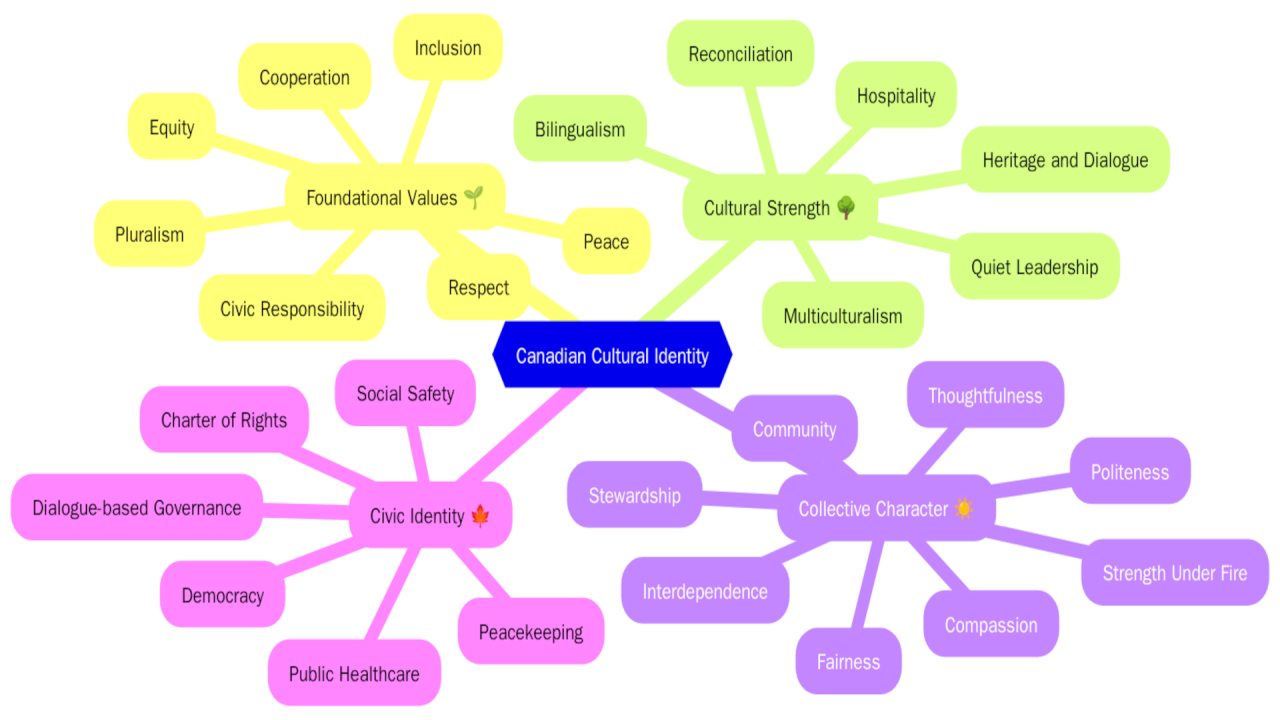
It is a dialogue between histories, between peoples, and between different visions of a shared future. We have never relied on sameness. Instead, we have built our core identity on a quiet understanding that difference is not a threat but a strength. Our cohesion has not come from dominance or ideology, but from mutual respect, balanced pragmatism, and the belief that we do better when we build together.

This approach has served us well.

From universal healthcare to peacekeeping, from cooperative governance to broad public trust in our systems, Canada has often taken a slower road. A road shaped by consensus over conflict, stability over spectacle, and the idea that long-term thinking beats short-term wins.

Now we find ourselves facing a period of intense transformation. The questions are no longer abstract. They are present, pressing, and real. What kind of country are we, and what kind do we want to remain?

A Tangle of Pressures, All at Once

It would be easier if we were dealing with a single issue. Instead, we are navigating multiple, interconnected challenges that are unfolding simultaneously.

Our demographic structure is shifting. Birth rates are at historic lows, and the population is aging. This affects the sustainability of public services and puts pressure on the younger workforce. According to Statistics Canada’s 2021 census analysis, our society is entering a new phase where fewer working-age Canadians are supporting more retirees (source1) (source2).

Housing affordability has become a point of stress and inequality. Many younger Canadians feel locked out of the kind of stability their parents once expected. A recent piece by TVO outlines how the affordability crisis is now the “greatest source of inequality in Canada” (source1) (source2).

Environmental signals are getting stronger. Wildfires, floods, and changing agricultural seasons are increasingly visible. The Regional Perspectives Report from Natural Resources Canada highlights how climate impacts are not felt evenly, with different regions facing distinct pressures and risks (source1) (source2).

We are also experiencing deeper political division. What used to be healthy disagreement has turned into sharper ideological splits, driven in part by misinformation and frustration. According to the Public Policy Forum, polarization in Canada is real and growing, and it is weakening trust in institutions and one another (source1) (source2).

Technology is reshaping the nature of work faster than institutions can adjust. Automation and artificial intelligence are shifting the demand for skills and displacing traditional roles. Statistics Canada has documented this rapid shift in a report on the changing nature of work from 1987 to 2024 (source1) (source2).

At the same time, our population is growing through immigration. This remains essential to Canada’s long-term future. But rapid growth has outpaced our infrastructure and planning. A report from the Broadbent Institute shows that while Canadians continue to support immigration in principle, the stress on housing and services is causing concern and tension in many communities (source) (source).

Each of these challenges is real and complex. But they are also deeply interconnected. And the way we respond to them will shape the next chapter of our national identity.

The Values That Will Guide Us

When uncertainty rises, values become more than ideals. They become the framework for action.

In the Canadian context, our values have always reflected a balance of compassion and realism, idealism and practicality. This is the time to bring those strengths forward again.

Shared Responsibility Begins Where We Live

Democracy is not just a process. It is a habit. It begins in local communities, in public forums, in schools, and through everyday acts of listening and speaking up.

When people feel disconnected from civic life, it is rarely because they do not care. More often, it is because they do not feel heard. Rebuilding trust requires lowering barriers to participation and making it easier for people to contribute meaningfully. That means investment in civic tools, community leadership, and shared decision-making processes.

We have the capacity to do this. But it will take intention.

Constructive Coexistence Is Our Strength

Canada’s diversity is real. But diversity without connection can lead to fragmentation.

As communities grow and change, tensions may surface. Misunderstanding is natural. But division is not inevitable. We must build and maintain the spaces where people come together across differences. This includes language support, shared community hubs, and public policies that encourage integration and belonging.

These efforts are not symbolic. They are practical tools for national stability.

Innovation Should Solve Real Problems

Canada is well positioned in global technology, especially in artificial intelligence. But innovation must serve a purpose beyond disruption.

We should be applying innovation where it helps solve everyday issues: in housing, health systems, public transportation, and education. This also means preparing workers for the shifts underway by providing accessible training, adaptable credentialing, and real transition support.

The Future Skills Center offers a road-map for aligning technological change with human needs (source).

Let us ensure innovation works for people, not just markets.

Fair Opportunity Is the Foundation of Stability

Fairness is a deeply Canadian value. We expect a baseline of decency in how opportunities are distributed.

But fairness does not happen on its own. It requires thoughtful design and regular maintenance. We need to identify where access is falling behind and make targeted investments that correct imbalances without creating division.

A report from Generation Squeeze lays out how housing wealth, if left unchecked, will deepen generational inequality unless addressed directly (source).

This is about more than economics. It is about social trust.

Community Strength Is Real Infrastructure

Strong societies are built on relationships, not just transactions.

We need to expand how we think about infrastructure. Broadband access, elder care, mental health services, and public gathering spaces are all essential components of a connected society.

These are not optional or peripheral investments. They are what allow communities to thrive in moments of stress and change. They are what make us resilient.

The Past Shows Us What Is Possible

We have done this before. The pieces are already in our history.

Public healthcare started as a provincial idea that grew through persistence and public support. Our peacekeeping legacy showed that leadership can come from presence and principle rather than dominance. Canada’s leadership in ethical artificial intelligence reminds us that how we do something matters as much as what we do.

These examples are not accidents. They reflect deliberate choices, rooted in shared values and the will to act.

A Clearer Path Forward

This moment is not just about adapting to change. It is about deciding who we are while we do it.

Canada does not need to start over. We need to return to what has always worked: careful planning, mutual respect, and long-term vision.

This is not about blind optimism. It is about steady confidence rooted in experience. We know how to collaborate. We know how to build inclusive systems. And we know that trust is earned when people feel seen and supported.

I saw this trust growing up. My closest friends came from different cultural and faith backgrounds. We learned to navigate difference with curiosity and care. We did not agree on everything, but we did not have to. We shared food, celebrated one another’s milestones, and respected the stories we carried. In my own relationships, political perspectives ranged widely. But disagreement never meant distance, it meant dialogue. The core value was not sameness. It was acceptance and a commitment to the journey of greater understanding and the realization we were in this together.

Today, I see that value fraying. There is more withdrawal, more silence, and a deeper fear of difference. Conversations deteriorate to “cancel culture” call-outs using social media posts to gather mob support with the goal of strengthening ones position rather than engaging in personal conversations to work out differences. We need to restore the habit of staying in conversation, even when it is difficult. That is where trust lives and grows.

We also need to be mindful of the cultural influences we consume. Much of our media, language, and online discourse increasingly reflects divisions that originate outside our borders, especially from the United States. The polarization we see there is not inevitable here. But if we continue importing its tone, framing, and emotional triggers, we risk forgetting who we are. Canada has its own stories, its own challenges, and its own ways of working through difference. We need to protect that space, not abandon it.

We already have the values. Now we need to act like we believe in them. That is how we hold together in this time of transformation. Not by standing still, but by moving forward with clarity, care, and the willingness to walk together. Our identity has and still is strongly recognized and respected throughout the world, something you realize when travelling with a Canadian flag on your pack. We need to embrace this about ourselves and be proud of our uniqueness.

Enter your email to subscribe to updates.